




Cold room panel thickness is driven first by the temperature you need to hold: as a working rule, 75–100 mm for chillers (0 to +4 °C), 150–200 mm for freezers (−18 to −25 °C), and 200 mm or more for blast freezing (−30 to −40 °C). But temperature is only the starting point — the core material, your climate, the floor and the door traffic all move the right number. Here is how to get it right rather than guess.
Panel thickness by temperature: the starting point
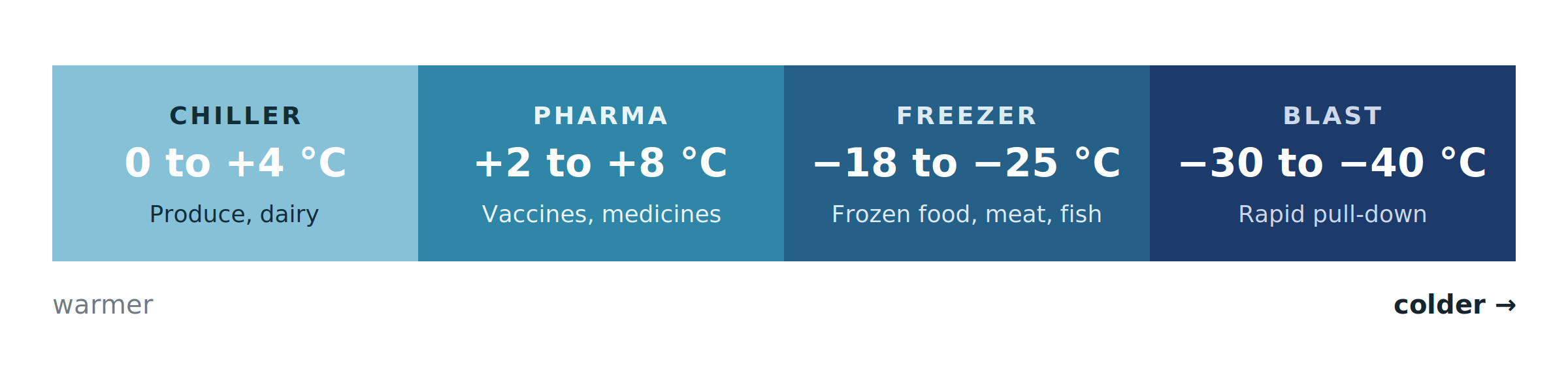
| Type de chambre | Température | Typical thickness (PIR/PU) | Common use |
|---|---|---|---|
| Chiller | 0 to +4 °C | 75–100 mm | Produce, dairy, beverages |
| Pharma / cool | +2 to +8 °C | 75–100 mm | Vaccines, medicines |
| Congélateur | −18 to −25 °C | 150–200 mm | Frozen food, meat, fish |
| Blast / deep freeze | −30 to −40 °C | 200 mm and above | Rapid pull-down, seafood |
The physics in one line — and why it’s really an energy decision
Heat always pushes from warm to cold, and the bigger the temperature gap, the harder it pushes. A panel resists that flow in proportion to its R-value, and R is simply the thickness divided by the core’s conductivity (R = thickness ÷ λ). Double the thickness and you roughly halve the conductive heat gain through the wall — which means the refrigeration runs less to hold the same temperature.
That is the real point: panel thickness is an energy decision dressed up as a construction detail. A chiller sits only a few degrees below the air around it, so a 75–100 mm panel copes easily. A blast freezer can be fighting a 60 °C-plus difference between inside and outside, so it needs far more insulation — otherwise the compressors run almost continuously and the electricity bill, not the build cost, becomes the expensive part of the room for the next twenty years.
The core changes the thickness
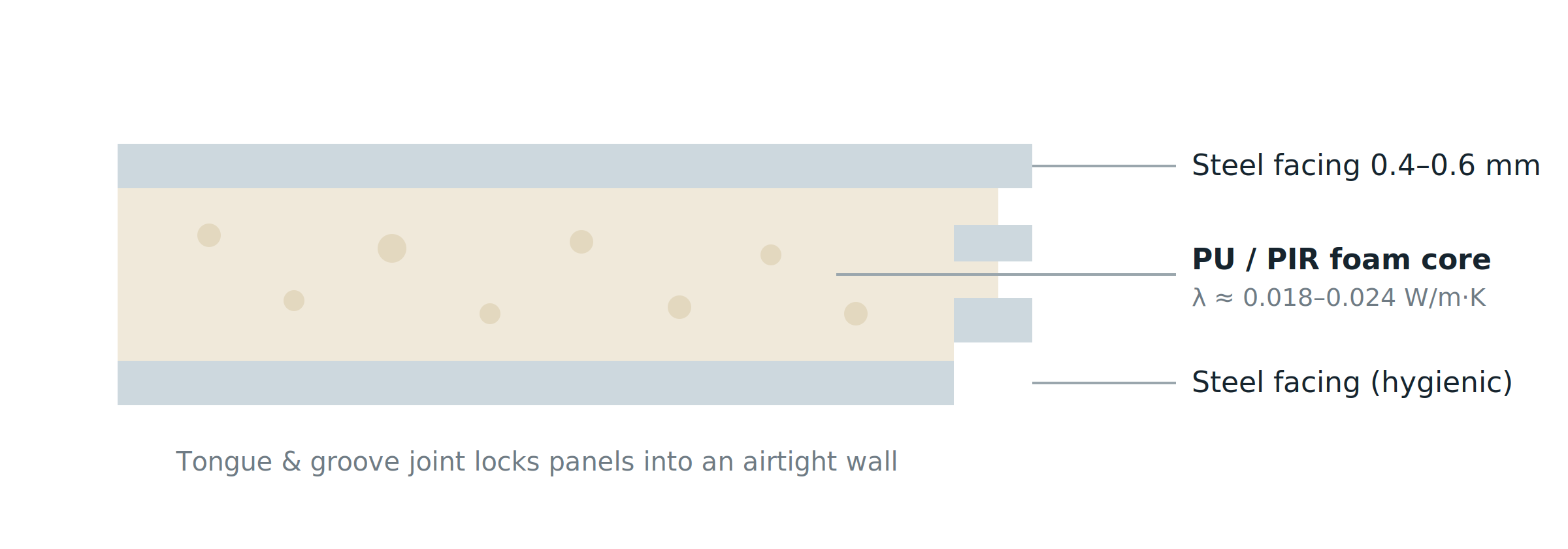
Thickness and core are one decision, not two, because a better-insulating core reaches the same performance in less depth:
- PIR (λ ≈ 0.018–0.024 W/m·K) — the cold-storage standard; best performance per millimetre and better fire behaviour, so it hits target R-values at the thicknesses in the table above.
- PU / PUR (λ ≈ 0.022–0.026) — very close to PIR, widely used, slightly less efficient.
- EPS (λ ≈ 0.033–0.038) — cheaper, but insulates less, so it needs noticeably more thickness for the same room; fine for chillers, rarely the right call for deep freeze.
- Rock wool (λ ≈ 0.036–0.041) — chosen for fire rating, not insulation; expect to add thickness where it is mandated.
So two freezers held at the same temperature can correctly use different panel thicknesses — one 150 mm in PIR, another 180–200 mm in EPS — for the same result. Always specify the thickness et the core together.
Hot or humid climate? Add thickness
The table assumes a temperate ambient. The hotter the outside air, the larger the temperature difference the panel has to hold, so a freezer in a 40 °C tropical climate often justifies a step up — say 200 mm where 150 mm would do in a mild one. Humidity matters too: in hot, wet climates a continuous vapour barrier and well-sealed joints are essential, because moisture driving into a cold core condenses, freezes, and quietly destroys the panel’s insulation value over time. In those conditions, thicker panels and airtight detailing pay for themselves.
Don’t forget the floor
Walls and ceiling get the attention, but freezer and blast rooms also need an insulated floor build-up — often matching the wall thickness — for two reasons: to stop heat rising from the ground, and to prevent frost heave, where the ground under a sub-zero room freezes, expands and cracks the slab. Larger freezers add under-floor heating or ventilation beneath the insulation to keep the earth from freezing at all. Chillers usually skip this, which is one more reason a freezer costs more per square metre than its wall panels alone suggest.
The panel is only as good as its joints and doors
A correctly thick panel still leaks if the system around it is weak. Heat finds the gaps: unsealed tongue-and-groove joints, a poorly insulated door, or a cold bridge where a steel section runs straight through the envelope. Matching the door insulation to the panel, sealing every joint and breaking thermal bridges matters as much as the millimetres — a 200 mm freezer with a leaky door performs like a far thinner one.
Three worked examples
- Chiller, temperate climate, light traffic — 0 to +4 °C, 100 mm PIR walls and ceiling, standard floor. Simple and efficient.
- Freezer, hot climate, busy dock — −20 °C in 38 °C ambient, 200 mm PIR throughout, insulated floor, vapour barrier, fast-acting insulated doors and an airlock to protect the cold at every opening.
- Blast room — −35 °C pull-down, 200 mm+ PIR walls, ceiling and insulated floor, sized for the heavy, swinging heat load of warm product coming in.
How to spec it: what to tell your supplier
You do not need to calculate R-values yourself — you need to give a supplier the five inputs that let them size it correctly: the target temperature, le product and how warm it arrives, your climate and ambient temperature, le door traffic, and whether the room is chill, freeze or blast. With those, the thickness, core and floor build-up follow.
In short: start from the temperature, choose the core, then adjust up for a hot or humid climate, a sub-zero floor and heavy door traffic. For the full picture of cores, R-values, refrigeration and cost, see our guide to cold storage solutions, or go deeper on choosing cold room panels.
Écrit par
L'équipe d'ingénierie VIKKINS
VIKKINS est une entreprise de construction en acier, opérée au Canada et fabriquée en Chine. Nos ingénieurs conçoivent et livrent des structures en acier et des systèmes de chaîne du froid clés en main à plus de 90 pays depuis deux bases de production à Cangzhou (Hebei) et Harbin (Heilongjiang), coordonnés par notre bureau de Montréal. Nous détenons les certifications ISO 9001, ISO 14001 et ISO 45001, les qualifications de soudage CE et CWB, ainsi qu'une qualification d'entreprise de structure en acier de niveau II, avec une capacité annuelle de 20 000 tonnes d'acier et 5 millions de m² de panneaux isolés. Ces articles sont rédigés à partir d'expériences de projets réels et sont revus par notre équipe d'ingénierie.
Construisons quelque chose ensemble
Indiquez-nous les dimensions et l'utilisation de votre projet – nous vous enverrons une conception préliminaire et un devis dans les 24 heures. Service en anglais, espagnol ou français.
| Obtenez un devis gratuit | Envoyez-nous un message sur WhatsApp dès maintenant |