




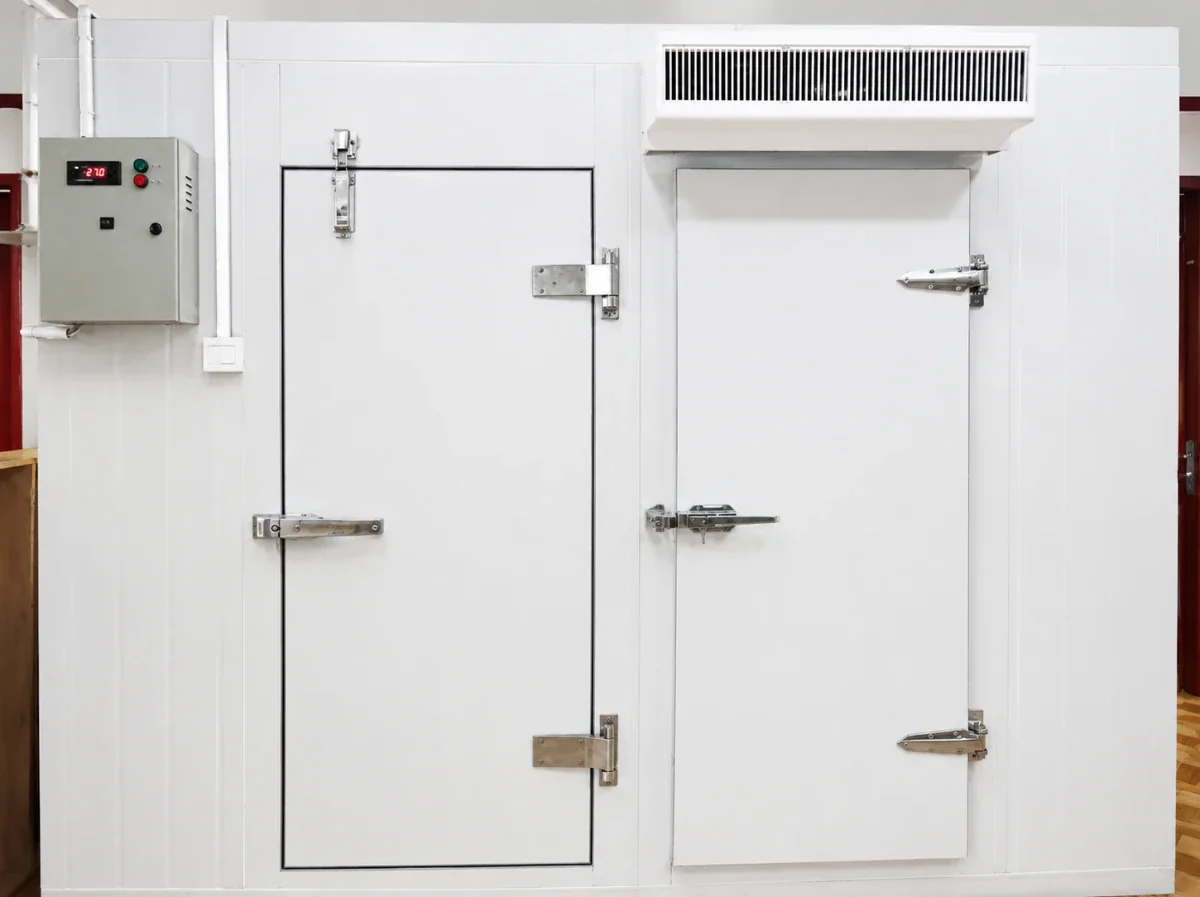
The panels get all the attention, but the cold room door is where most cold rooms quietly leak money. It is the one part that moves thousands of times, gets knocked by forklifts, and has to seal against a temperature gap that can top 50 °C. Get the door wrong and you pay for it every single day in energy, frost and condensation; get it right and it disappears into the background for a decade. This guide breaks down what actually decides whether a cold room door seals, insulates and lasts — and shows the door types Vikkins builds for each job — so you can spec one instead of guessing.
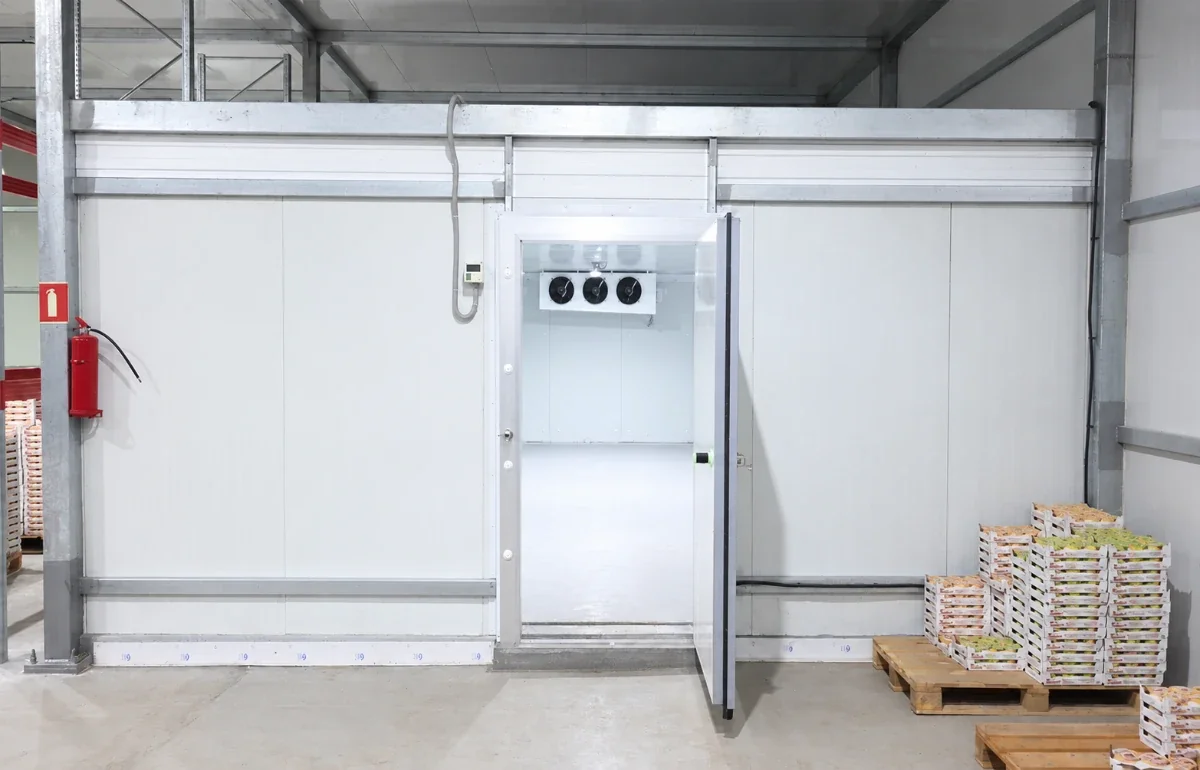
Why the door is the most overlooked part of a cold room
A cold room is only as good as its weakest seal, and that is almost always the door. Industry figures put the share of a cold room’s energy loss that runs through a poorly sealed door at up to a third. A door that closes a few millimetres out of true lets warm, humid air creep in, and that moisture shows up as ice on the frame, water on the floor and frost on the goods. None of that is a refrigeration fault — it is a door fault, and it is completely avoidable at the spec stage.
1. Door skin: coated steel or stainless
The skin decides how the door copes with cleaning, corrosion and knocks. Vikkins doors take a rigid polyurethane foam core with a choice of face material:
- 304 stainless steel — corrosion-resistant, easy to clean, food-grade. The right choice for food processing, meat, seafood and pharmaceutical rooms, where hygiene inspections check for it.
- Colour-coated steel — best value for general storage and logistics rooms. In a cold, humid room insist on a proper galvanising layer (around 80 g/m² or more), or the skin rusts within a couple of years.
Match the skin to the room: humid and wash-down rooms prioritise corrosion resistance and hygiene; deep-freeze rooms prioritise a skin that stays tough at low temperature.
2. The seal is where the cold actually escapes
A cold room door seal is not a strip of rubber to treat as an afterthought. Three details separate a seal that holds from one that fails in a season:
- Gasket material. Use EPDM (ethylene propylene rubber), which stays flexible down to about −40 °C. Cheap PVC gaskets harden and crack at low temperature and need replacing within two years.
- Gasket shape and compression. A multi-chamber, air-bulb profile with meaningful compression seals far better than a flat single strip.
- Frame heating for freezers. Any room at −18 °C or colder needs a heater strip around the door frame, or the frame ices up and the door freezes shut. On Vikkins 150 mm freezer doors a heating strip is fitted as standard; on 100 mm doors it is optional.
A quick way to verify a finished door: release a little smoke inside the closed room; if none escapes at the edges, the seal is good. A healthy seal lasts five to eight years — frosting, dripping or a draught at the edge is the signal to replace the gasket.
3. Insulation: thickness and core density both matter
The door has to insulate as well as the wall around it, so its rigid PU core is spec’d the same way as an panneau sandwich isolant. Two numbers decide performance:
- Core density: a quality rigid polyurethane core runs about 40–45 kg/m³. Under-density cores hide voids that turn into cold bridges, frost lines and condensation.
- Thickness: Vikkins hinged doors come in 100 mm for chillers and 150 mm for low-temperature and freezer rooms — the same logic as choosing your cold room panel thickness.
Watch for the common trap of a door that is the right thickness but under-density. Ask for the measured core density, not just the millimetres, and keep the door in step with the wall panels around it.
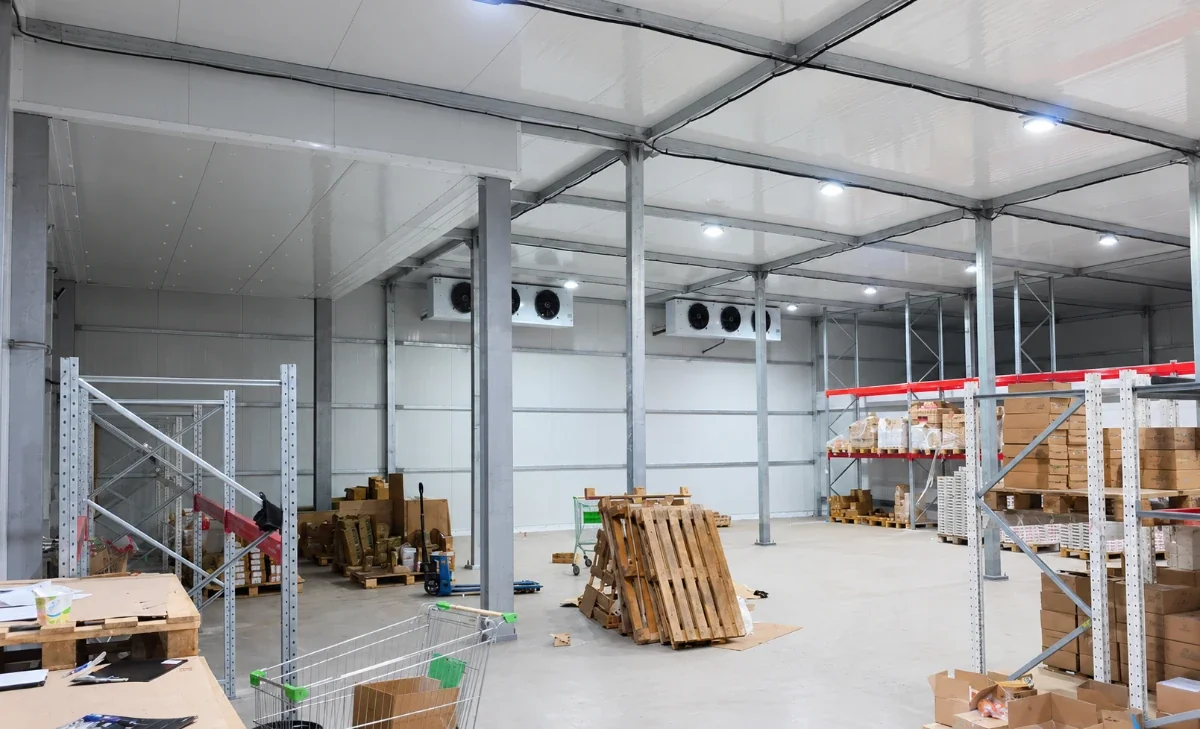
4. Door types Vikkins builds — match the door to the traffic
Size the opening to how the room is actually used, then pick the door type by how often and how fast it opens. Vikkins builds four families:
- Single-leaf hinged (semi-recessed, or fully-recessed with an auto-return closer) — the everyday choice for personnel and small rooms.
- Double-leaf hinged (bar-handle or bow-handle lock) — for wide openings where pallets and forklifts pass through.
- S Series high-speed spiral door — a rigid spiral-rail door available from 2 to 10 cm thick, opening at peak speeds above 4 m/s. For busy openings, the faster the door clears, the less cold you dump; circular, elliptical and low-threshold rail options suit different headroom and safety needs.
- R Series high-speed rolling door — an economical fabric door, two 0.8 mm skins over a 20 mm insulation layer, opening and closing fast to stop cold-and-warm air mixing at the doorway.
As a rule of thumb: hinged doors for low-frequency openings, high-speed spiral or rolling doors for heavy traffic where the seconds a door stands open add up. Doors are one component of the whole room, so it helps to settle them alongside your overall dimensionnement de chambre froide.
5. Hardware and safety: the inside release nobody checks
Hardware is where a cheap door shows its true cost — and where one detail is non-negotiable for safety:
- Inside emergency release. Every cold room and freezer door must open from the inside, even when locked. On Vikkins doors this internal emergency release device is fitted as standard; missing it has trapped people inside freezers, so check it exists before anything else.
- Hinges and locks. Stainless, load-rated hinges with bearings, and a solid lever or bar/bow handle lock. Un-bearinged hinges seize and the door sags within months.
- Anti-frost heating. On freezer doors the frame and threshold should be heated so the door never ices shut.
- Options that earn their place. An anti-fog glass viewing window lets staff check a room without opening it, and an air-curtain mounting point holds the cold in at high-traffic doorways.
Three door-buying mistakes that cost more later
- Buying on looks. A tidy finish means nothing if the core is under-density and the gasket is PVC.
- Cutting material corners. A thin galvanising layer or a lightweight hinge saves a little now and fails within a year or two.
- Copying someone else’s spec. A door built for a chiller in a temperate market is the wrong door for a freezer in a hot, humid one. Spec to your temperature and climate.
Because Vikkins manufactures both the panels and the doors, the door core, thickness, skin and hardware are matched to your temperature band and climate rather than pulled from stock — the same discipline behind our cold storage solutions.
Questions fréquemment posées
What is the best material for a cold room door?
304 stainless steel for food and pharmaceutical rooms, where hygiene matters; colour-coated galvanised steel for general storage. Both go over a rigid polyurethane core; match the skin to the room’s cleaning and corrosion demands.
Why does my cold room door ice up or drip?
Almost always a seal or heating problem: a hardened or damaged gasket letting humid air in, or a missing frame heater on a freezer door. Warm moist air condenses and freezes at the edges. Replace the gasket and check the frame heating strip.
What thickness should a cold room door be?
Around 100 mm for chiller rooms and 150 mm for freezer and low-temperature rooms, with a rigid PU core of about 40–45 kg/m³. Keep the door in step with the wall panels around it.
Which cold room door opens fastest for busy traffic?
A high-speed door. Vikkins S Series spiral doors reach peak speeds above 4 m/s, and R Series rolling doors open and close quickly too — both cut the time the room stands open, which is where most cold is lost at a busy doorway.
Can a cold room door be opened from the inside?
It must be. An internal emergency release is a mandatory safety feature on every cold room and freezer door, fitted as standard on Vikkins doors, so anyone inside can get out even when the door is locked.
Indiquez-nous les dimensions et l'utilisation de votre projet – nous vous enverrons une conception préliminaire et un devis dans les 24 heures. Service en anglais, espagnol ou français.