




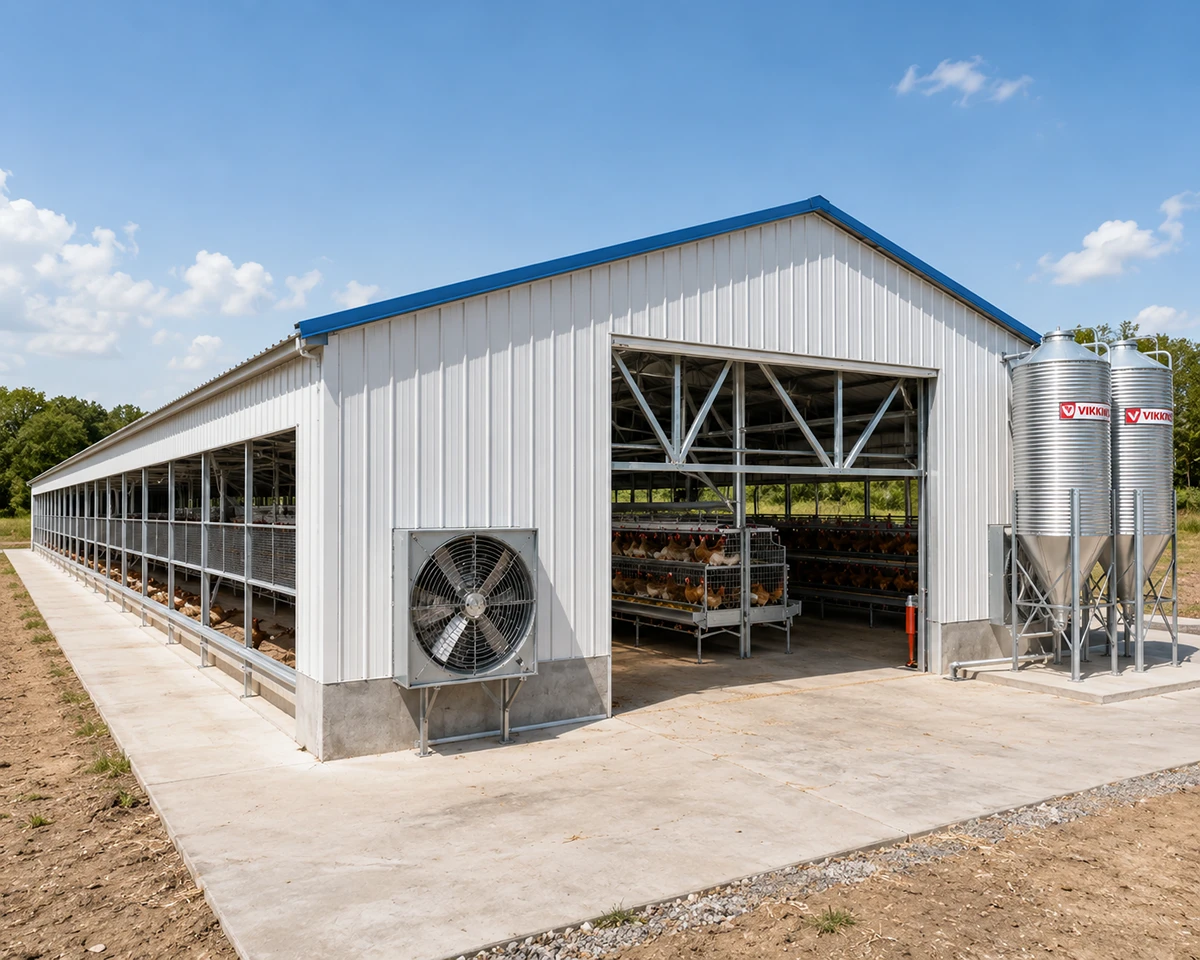
A farm manager in Shandong watches his layer house ventilation system environmental control strategy deliver 92 eggs per hundred birds per day. Fifty kilometers away, an identical flock in identical cages—but housed in a building with poor ventilation system design and inadequate environmental control—produces only 78 eggs per hundred birds.
This 15-point gap costs that second farmer approximately 40,000 yuan per month in lost production. Over a 72-week productive cycle, that is more than 1 million yuan in foregone revenue from a single layer house with inadequate ventilation and environmental control. The difference: proper layer house ventilation system environmental control design.
The difference is almost always environmental control—specifically, the ability to manage air quality, temperature, and humidity with precision through a professional layer house ventilation system. And the foundation of all that control is proper ventilation system design and environmental monitoring.
The Hidden Cost of Poor Ventilation: Ammonia Gas and Respiratory Disease
Ammonia (NH₃) is invisible. It is odourless below certain thresholds. And it is the single largest driver of production loss in poorly ventilated layer houses.
Here is the mechanism:
At 5 ppm ammonia concentration: Respiratory mucous membranes begin to inflame. Blood vessels congest. The bird’s upper respiratory tract develops oedema. This is subclinical—the farmer sees no obvious illness—but the bird is mounting an immune response to a toxic gas.
At 20 ppm: Secondary bacterial infections become inevitable. Escherichia coli and Mycoplasma exploit the damaged epithelium. Laying rate begins to drop measurably.
At 100 ppm (0.1 mL/L): A 80% laying flock drops to 60% within 10 days. This is no longer subclinical. This is production collapse.
The international standard is simple: ammonia must remain below 10 ppm at all times. Sulphur dioxide must stay below 8 ppm. CO₂ must not exceed 0.15%.
Yet in farms with undersized or poorly designed ventilation, ammonia routinely hits 30–50 ppm during warm months when humidity is high and litter moisture drives decomposition. The farmer attributes the 20% production loss to viral disease or feed quality. The real culprit is air quality.
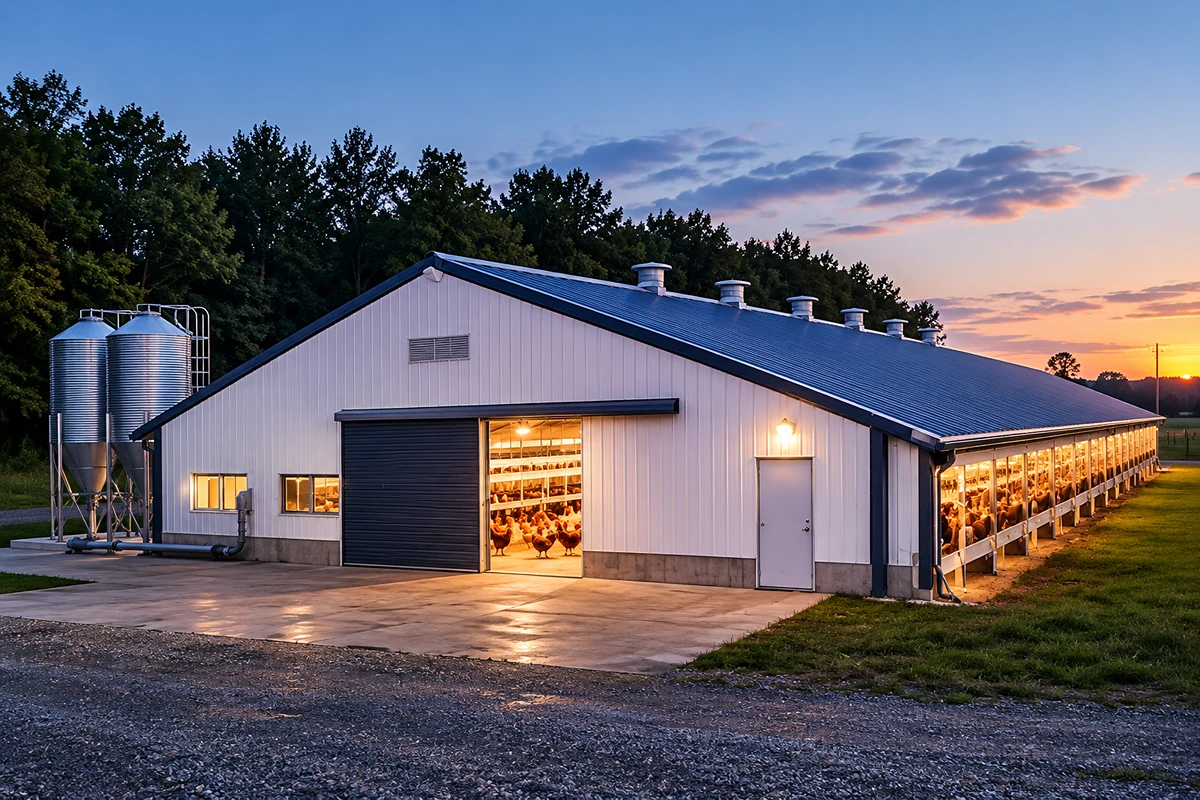
Ventilation System Sizing: The Standard That Separates High Producers From Low
Ventilation capacity is measured in cubic meters per hour (m³/h) per kilogram of bird body weight. This is the international standard used by every major breeding company and environmental control system manufacturer.
Standard ventilation requirement for layers:
Adult layer hens (2.3 kg): 4.76 m³/h per kilogram body weight
This means a house with 30,000 hens at 2.3 kg average body weight requires:
30,000 × 2.3 kg × 4.76 m³/h/kg = 330,480 m³/h minimum fan capacity
But this is winter capacity—when outdoor temperature approaches or equals indoor setpoint. In summer, when heat dissipation becomes the limiting factor, the required air exchange rate jumps:
Seasonal air exchange standard:
– Hot season (outdoor > 25°C): Complete air exchange every 1 minute
– Moderate season (15–25°C): Complete air exchange every 2 minutes
– Cold season (< 15°C): Complete air exchange every 3 minutes
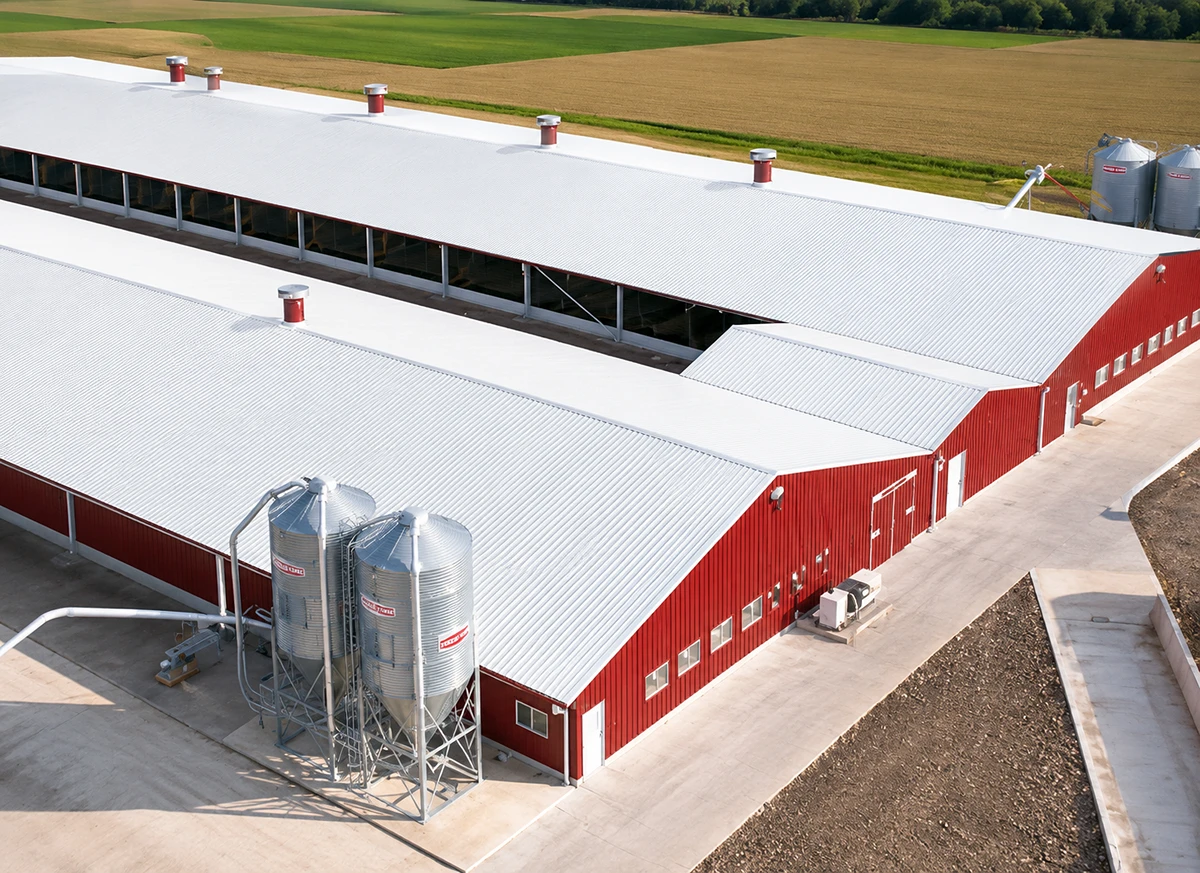
A house with 100 m length × 12.5 m width × 4 m height (5,000 m³) must exchange all air in 1 minute during heat stress. That requires fans capable of 5,000 × 60 = 300,000 m³/h.
Farms that size fans to only winter demand (lower capacity, lower cost) will always face ammonia spikes during warm weather. Laying rate collapses. Feed conversion worsens. Secondary infections increase mortality.
The farmer then blames the bird genetics or the feed formulation. But the real cause was capital underinvestment in the ventilation system at day one.
Ammonia Production and Litter Management: The Link Nobody Makes
Ammonia does not appear magically. It comes from manure—specifically from uric acid decomposition under warm, moist conditions.
Higher litter moisture + higher temperature = higher ammonia production rate. When ventilation capacity is marginal, this ammonia accumulates.
But ventilation alone is not enough. The building envelope itself must support the ventilation strategy:
The building must be:
1. Thermally sealed – Prevent uncontrolled infiltration that bypasses the ventilation system and creates dead zones with high ammonia
2. Structurally sound – Negative pressure control (−15 to −25 Pa) requires tight construction; leaky buildings cannot maintain pressure differentials
3. Properly insulated – Thermal stability reduces temperature swings that trigger ammonia release from litter
Many farms use cage systems rated for 10,000 birds but house them in corrugated-metal buildings with gaps in the roof and walls. The ventilation fans run constantly, energy costs soar, temperature swings are wild, and ammonia still spikes because the building leaks air in uncontrolled locations.
Multi-House Separation and Biosecurity: Why Environmental Isolation Matters
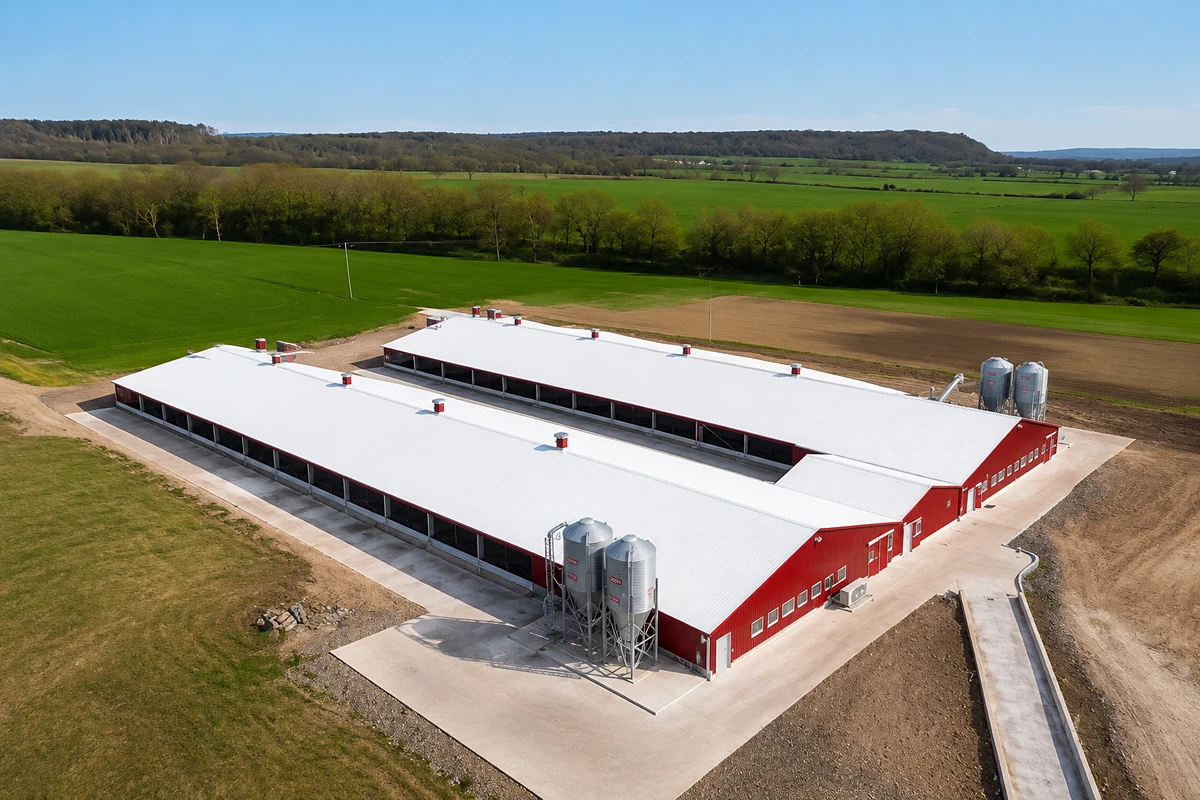
Modern layer farms do not house 30,000 birds in a single building. They use separate houses—typically 5,000–10,000 birds per unit—because biosecurity requires age segregation and rapid depopulation cycles.
A single infected house must be cleanable and disinfectable without affecting the adjacent, productive house. This requires:
– Independent ventilation systems (no shared ductwork)
– Separate entrance/dressing areas
– Negative pressure maintained only within the target house
– No cross-contamination via shared air handling
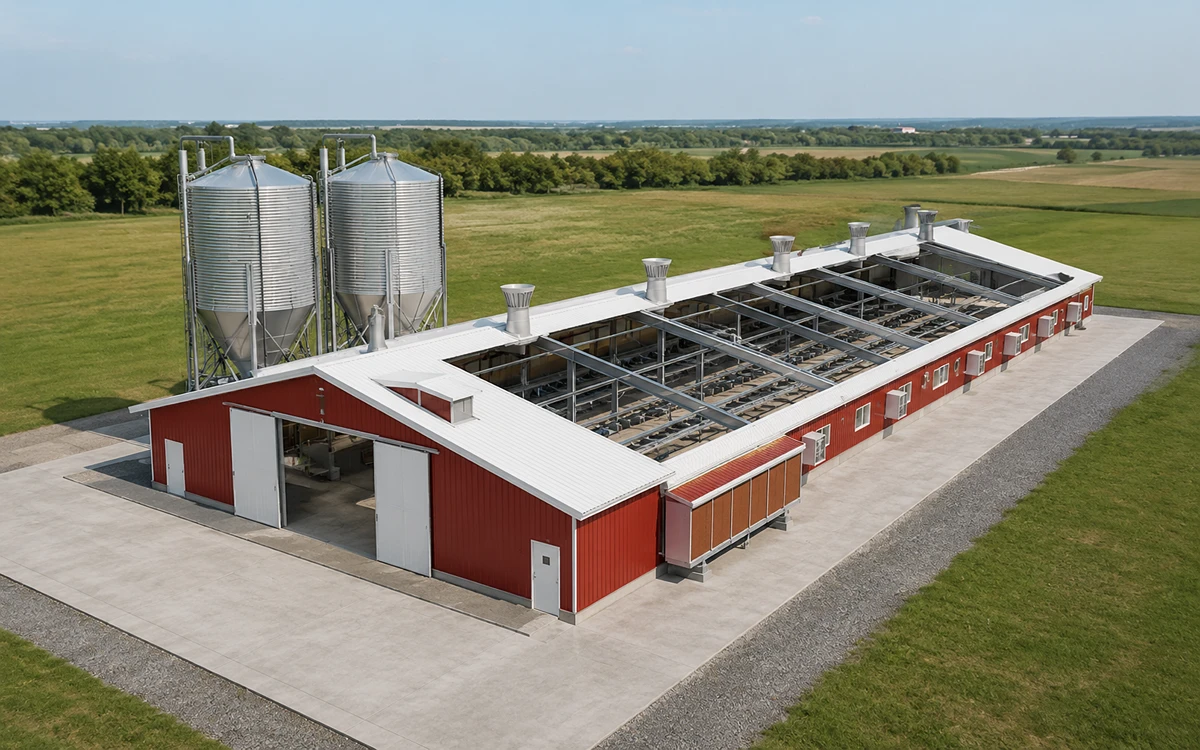
When ventilation systems are properly engineered for each house independently, the farm gains:
1. Ammonia control in each unit without interference from adjacent units
2. Ability to quarantine and treat a single diseased house
3. Flexibility in lighting, feeding, or medication schedules across different age groups
4. Easier compliance with environmental regulations (each house can be monitored separately)
The capital cost is higher—multiple ventilation systems instead of one central system. But the operational cost is lower because energy is spent only on occupied houses, and production loss from cross-house disease is eliminated.
The Difference a Professional Layer House Makes: Real Numbers
Consider two scenarios, both 30,000 hens, both 72-week cycles:
Farm A: Undersized Ventilation, Leaky Building
– Winter ammonia: 12–15 ppm (marginal, above standard)
– Summer ammonia: 45–60 ppm (toxic, disease-prone)
– Average laying rate: 78 eggs/100 birds/day
– Mortality: 8% over 72 weeks
– Feed conversion: 1.95 kg feed per kg eggs
– Total cycle revenue: ~2.8 million yuan
– Total costs (including disease treatment, higher feed): ~1.95 million yuan
– Profit: ~850,000 yuan per house
Farm B: Professional Ventilation Design, Thermally Sealed Building
– Winter ammonia: 5–8 ppm (safe)
– Summer ammonia: 8–12 ppm (safe, excellent flock comfort)
– Average laying rate: 93 eggs/100 birds/day
– Mortality: 3.5% over 72 weeks
– Feed conversion: 1.78 kg feed per kg eggs
– Total cycle revenue: ~3.35 million yuan
– Total costs (lower disease, better feed efficiency): ~1.82 million yuan
– Profit: ~1.53 million yuan per house
Profit difference per house per cycle: ~680,000 yuan
Over a 10-year asset life with 5 cycles per cycle period = 34 million yuan additional profit from a single professionally designed house.
The capital cost difference between undersized ventilation and professionally engineered ventilation is typically 15–20% of total house cost. On a 5-million-yuan house, that is 750,000–1,000,000 yuan investment. Payback from a single production cycle.
Why VIKKINS Specializes in Layer House Design
We build professional poultry house designs et steel-structure layer facilities because environmental control is not an afterthought—it is the architecture.
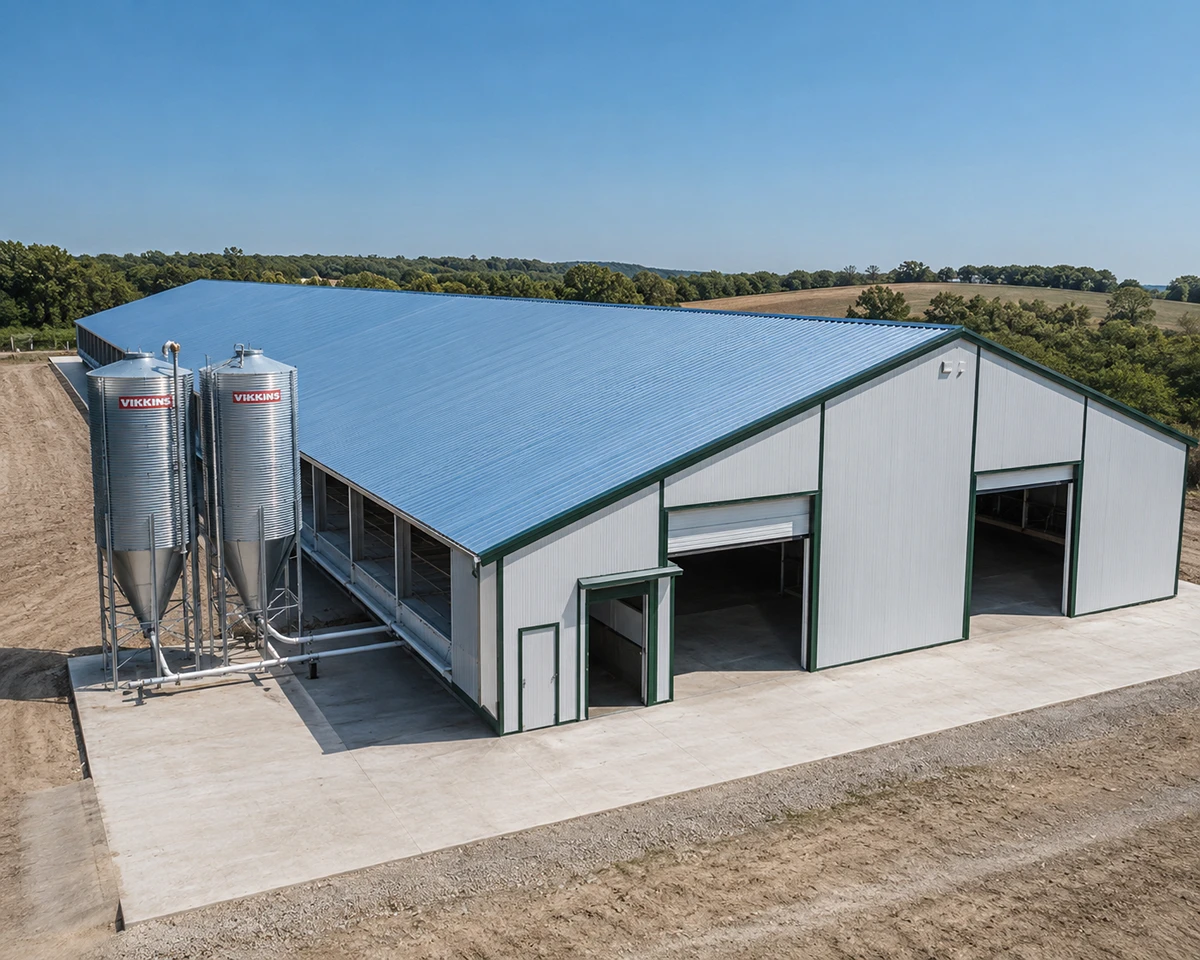
Our approach:
1. Envelope Thermal Performance – We design for R-values that minimize temperature swing between day and night, reducing ammonia volatility from litter.
2. Ventilation Integration – Inlet and outlet placement are modeled to avoid short-circuiting and dead zones. Air speed at bird level is calculated to prevent drafts while ensuring complete air exchange.
3. Structural Integrity – Steel structure with insulated sandwich panels maintains the pressure differential required for negative pressure control. No air leakage through gaps or corroded seams.
4. Modular Expansion – Modular building systems allow a farm to scale from 3 houses to 10 without redesigning environmental control strategy.
5. Documentation and Compliance – Structural engineering documentation, ventilation system drawings, and environmental monitoring protocols are provided—not left to the farmer to figure out.
The Question for Your Farm
If your layer house is producing 78 eggs per 100 birds when genetics and feed should deliver 95, the first question is not “What is wrong with the feed?” or “Is there a hidden virus?”
The first question is: “Is the building maintaining ammonia below 10 ppm in all seasons?”
If the answer is unknown—if you do not have a gas monitoring system, or you have one but do not check it regularly—you are losing 15–20% of production to invisible air quality degradation.
A professional layer house design prevents this. It ensures that environmental parameters remain stable from week 1 to week 72, that ammonia never spikes, that secondary infections remain rare, and that the genetic potential of your flock is realized in eggs, not lost to respiratory stress.
The cost difference is real. The payback is faster.
Written by the VIKKINS Engineering Team. VIKKINS is a Canada-operated, China-manufacturing steel building company delivering professional poultry house designs and turnkey layer facilities to farms across Asia, Europe, and Africa. We combine structural engineering expertise with flock environmental science to maximize production efficiency and bird welfare. ISO 9001 / 14001 / 45001 certified, with an annual capacity of 20,000 tonnes of steel and 5 million m² of insulated panels.
Is Your Layer House Losing 15% Productivity to Poor Ventilation?
Tell us your current flock size, house dimensions, and average laying rate. Our environmental engineering team will conduct a 24-hour ammonia and CO₂ audit, model your ventilation system against international standards, and provide a report with specific recommendations. Many farms discover 8–12 ppm ammonia spikes they were never monitoring.