




Accueil / Connaissance des produits / Qu'est-ce qu'une chambre froide pour conteneurs ?
Si vous avez besoin d'un entrepôt frigorifique mais que vous ne pouvez pas — ou ne souhaitez pas — construire une pièce fixe sur place, un chambre froide pour conteneurs C'est souvent la solution la plus rapide. Il s'agit d'une chambre froide conteneurisée, livrée complète et prête à l'emploi, installée dans un conteneur maritime : branchez-la et vous disposez d'un refroidisseur ou d'un congélateur opérationnel dès le jour même. Cependant, la notion de “ chambre froide conteneurisée ” varie selon les fournisseurs, et il est important de bien choisir. Ce guide explique ce qu'est une chambre froide conteneurisée, en quoi elle diffère d'une chambre froide traditionnelle intégrée et d'un conteneur frigorifique, et comment déterminer si elle convient à votre activité.
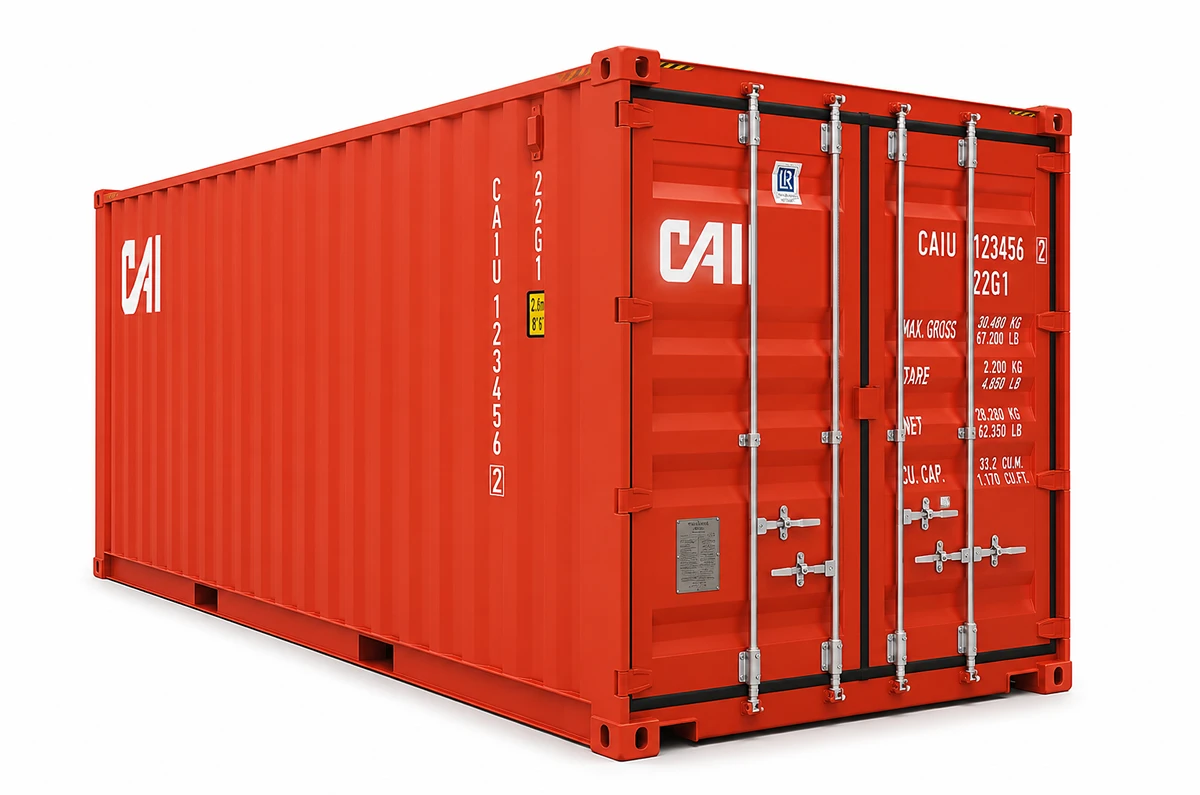
Une chambre froide conteneurisée de 20 pieds — une chambre froide entièrement accessible à pied dans une structure en acier robuste et transportable.
Qu'est-ce qu'une chambre froide pour conteneurs ?
Une chambre froide conteneurisée est une unité de stockage frigorifique autonome intégrée dans un conteneur maritime standard de 20 ou 40 pieds. Le conteneur est revêtu de panneaux sandwich isolants et équipé de son propre groupe frigorifique, d'une porte et de commandes. L'ensemble fonctionne ainsi comme une véritable chambre froide accessible à pied, mais transportable par camion grâce à une grue. Vous bénéficiez ainsi de l'isolation et du contrôle de la température d'une chambre froide traditionnelle, dans une structure en acier robuste, étanche et transportable.
L'atout majeur : il est livré comme un produit fini. Contrairement à une chambre froide traditionnelle construite sur site et livrée en kit, une chambre froide conteneurisée quitte l'usine entièrement équipée — isolée, réfrigérée et câblée — et est prête à l'emploi dès son arrivée sur site et son raccordement électrique.
Chambre froide conteneurisée vs conteneur frigorifique — une distinction importante
Ces deux éléments sont souvent confondus, et la différence est importante lors de l'achat. réfrigérateur est réfrigéré expédition Conteneur, conçu principalement pour maintenir la marchandise au frais pendant son transport maritime ou routier. chambre froide pour conteneurs est un stockage Chambre froide utilisant un conteneur comme enveloppe — conçue pour maintenir une température stable en tant que pièce de plain-pied fixe, avec des panneaux isolants appropriés et un groupe frigorifique de qualité chambre froide.
En résumé : un conteneur frigorifique est conçu pour le transport de marchandises ; une chambre froide conteneurisée est conçue pour leur stockage. Si votre objectif est le stockage frigorifique sur site plutôt que le transport, une chambre froide conteneurisée dédiée vous offre une meilleure isolation, un accès plus facile et une réfrigération adaptée à vos besoins de stockage.
Chambre froide conteneurisée, chambre frigorifique ou chambre intégrée : une comparaison objective
En pratique, vous devez choisir entre trois options, et non deux. Voici les différences :
| Facteur | chambre froide pour conteneurs | Conteneur frigorifique | Chambre froide intégrée traditionnelle |
| Conçu pour | Stockage stationnaire | Marchandises en transit | Stockage stationnaire |
| Isolation | PIR de 100 à 200 mm, épaisseur adaptée à l'usage | Généralement autour de 60 à 90 mm, fixe | Dimensionné pour la tâche |
| Déploiement | Livré complet, fonctionnel le jour même de sa mise en service | Livré complet | Construit ou assemblé sur place en quelques jours |
| Mobilité | Déplacé à la grue et déplacé à chaque déplacement de travaux | Entièrement mobile | Permanent — ne peut être déplacé une fois construit |
| Travaux sur le site | Minimal — une base plane et une alimentation électrique | Minimal | Fondations, assemblage et aménagement requis |
| Accéder | Porte de chambre froide, agencement de type dressing | Portes de chargement à une extrémité, plancher en T | Personnalisé |
| Capacité | Environ 10 tonnes en 20 pieds, 20 tonnes en 40 pieds | Coque similaire, volume utile réduit une fois les jeux de flux d'air de transit conservés. | Sur mesure — des petites pièces aux grands entrepôts |
| Meilleur pour | Entrepôt frigorifique rapide, flexible, mobile ou à distance | marchandises en déménagement | Grand entrepôt permanent à emplacement fixe |
Aucun de ces trois systèmes n'est universellement supérieur. Une chambre froide conteneurisée l'emporte en termes de rapidité, de mobilité et de simplicité. Un conteneur frigorifique est préférable lorsque les marchandises doivent être transportées. Une chambre froide intégrée est la solution idéale lorsqu'on a besoin d'une grande capacité de stockage permanente à un emplacement fixe.
Comment est construite une chambre froide en conteneurs
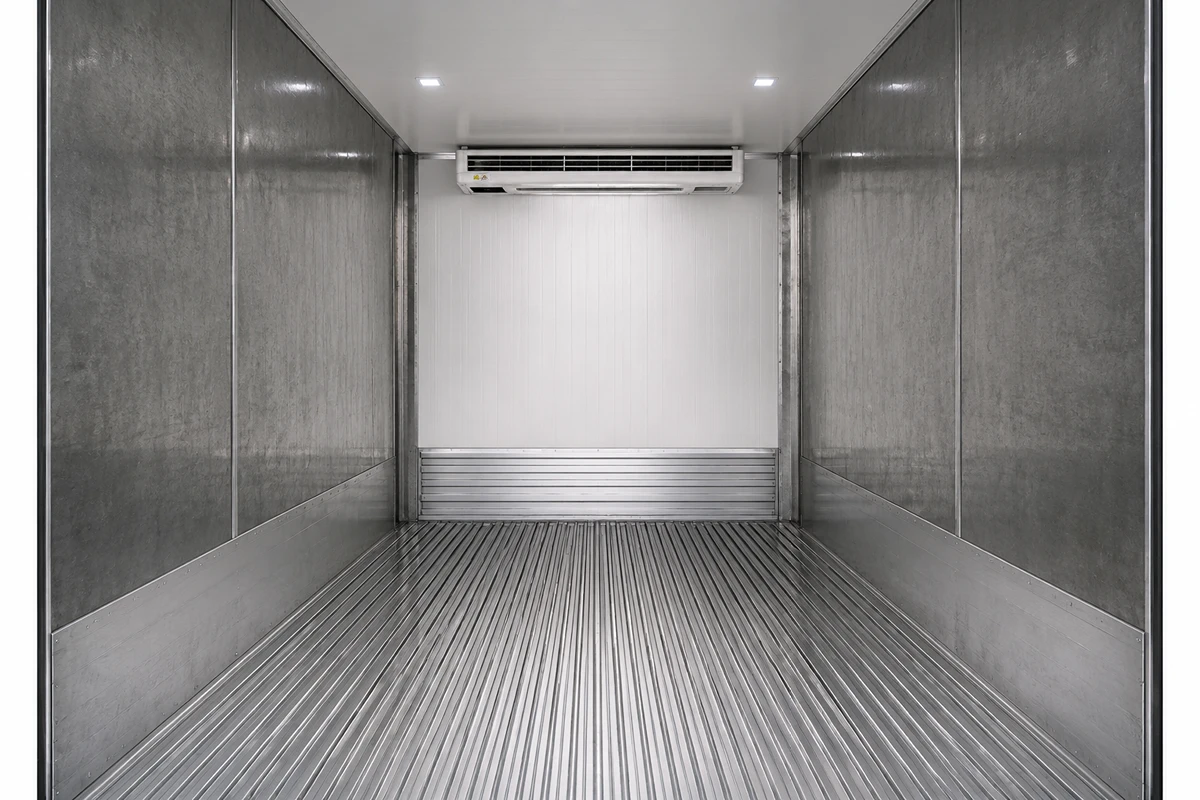
À l'intérieur, c'est une véritable chambre froide — des panneaux isolants, un évaporateur et un véritable plancher, et non pas une simple boîte tapissée.
À l'intérieur de la coque en acier du conteneur, une chambre froide conteneurisée est une véritable chambre froide, conçue selon les mêmes principes que tout entrepôt frigorifique de qualité :
- Panneaux isolés. Le conteneur est revêtu de panneaux sandwich PIR d'une densité d'âme d'environ 40 kg/m³, avec une conductivité thermique d'environ 0,022 W/(m·K). L'épaisseur est dimensionnée en fonction de la température cible et n'est pas fixe.
- Puissance frigorifique (0 à +4 °C) : 100–120 mm
- Fonctionnement du congélateur (−18 à −25 °C) : 150–200 mm
L'isolation est essentielle pour maintenir une température stable et réduire les coûts d'exploitation ; c'est le principal facteur de la facture énergétique d'une chambre froide, et le point faible le plus fréquent des appareils bon marché. Si un fournisseur vous propose des panneaux de 120 mm pour une température de fonctionnement de -20 °C, demandez-lui pourquoi.
- Un groupe frigorifique intégré. Un onduleur prêt à l'emploi, adapté à votre température cible et à la température ambiante de votre site. La régulation par variateur de fréquence (Inverter) maintient la température avec précision et consomme nettement moins d'énergie qu'un fonctionnement à vitesse fixe. La puissance ambiante nominale est la spécification la plus souvent négligée par les acheteurs, et pourtant, c'est elle qui détermine discrètement le bon fonctionnement de l'appareil. Les puissances indiquées dans les catalogues sont généralement publiées pour 32 °C ou 35 °C. Un appareil d'une puissance nominale de 10 kW à 35 °C peut ne fournir que 6 à 7 kW à 43 °C, soit une perte d'un tiers, voire plus, précisément au moment où vous en avez le plus besoin.
Pire encore, ce n'est pas la prévision météo qui compte, mais la température de l'air entrant dans le condenseur. Or, sur le toit d'un conteneur exposé au soleil ou dans un coin abrité, cet air peut être de 10 à 18 °C supérieur à la température relevée par la station météo la plus proche. Dans une ville où il fait 32 °C, l'air qui arrive au condenseur peut atteindre 42 °C.
Pour les sites nécessitant une configuration renforcée, nous utilisons des modèles haute température ambiante avec des serpentins de condensation agrandis, plutôt que les modèles standard. Indiquez-nous la température maximale prévue sur votre site et l'emplacement de l'unité ; nous la dimensionnerons en fonction du volume d'air qu'elle traitera.
- Porte de chambre froide et accessoires. Une porte isolée conforme, un évaporateur, un éclairage, un câblage et des aérateurs à pression équilibrée — tout ce dont une pièce de plain-pied a besoin, pré-installé.
- Le conteneur lui-même. Un conteneur standard 20GP ou 40GP offre une enveloppe robuste, résistante aux intempéries, empilable et prête pour le transport maritime, qui protège la pièce pendant le transport et en service.
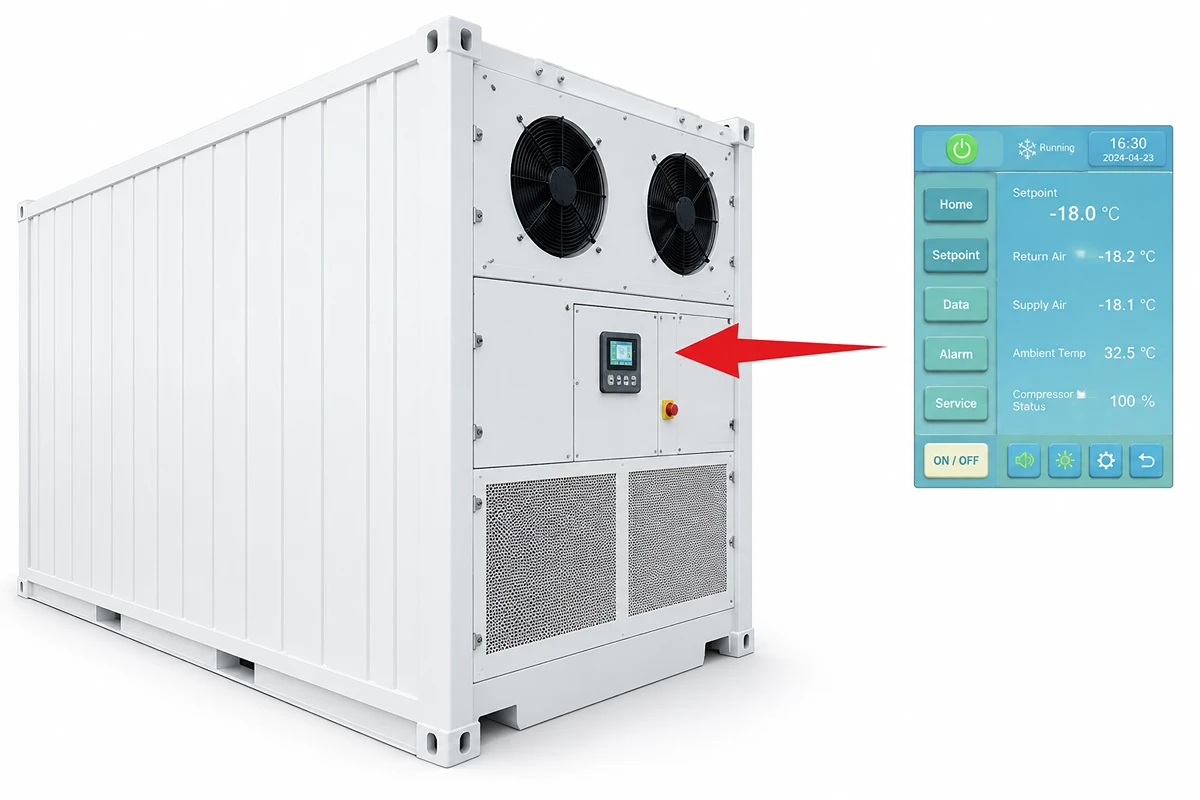
Un groupe frigorifique à inverseur prêt à l'emploi, adapté à la température cible et livré pré-installé.
Types de chambres froides pour conteneurs
Les chambres froides pour conteneurs ne constituent pas un produit unique. Les principales variantes sont :
- 20 pieds (environ 10 t) et 40 pieds (environ 20 t). Deux formats standard sont disponibles. À noter avant de commander : les dimensions intérieures du conteneur et les dimensions utiles de la chambre froide finie sont différentes. L’isolation intérieure occupe de l’espace.
20 pieds 40 pieds interne du conteneur 5,90 × 2,35 × 2,39 m (≈33 m³) 12,03 × 2,35 × 2,39 m (≈68 m³) Chambre froide utilisable, panneau de 120 mm ≈5,66 × 2,11 × 2,15 m (≈26 m³) ≈11,79 × 2,11 × 2,15 m (≈53 m³) Cela représente environ un cinquième du volume perdu à cause de l'isolation, et les panneaux de congélation plus épais absorbent davantage de cette perte. Nous vous communiquons ces deux chiffres lors de l'établissement du devis, afin d'éviter toute surprise à la livraison.
- Réfrigérateur ou congélateur. Configuré selon votre température (par exemple, entre -20 et +2 °C pour une utilisation en congélateur/réfrigérateur), avec une épaisseur de panneau et une capacité de réfrigération adaptées. Les versions congélateur/réfrigérateur à double usage peuvent être utilisées alternativement en mode congélateur et en mode réfrigérateur.
- Chambre froide autonome en conteneur solaire. Voici la solution révolutionnaire pour les sites isolés et les zones à faible couverture réseau. Une chambre froide conteneurisée, associée à un système photovoltaïque, un onduleur et un parc de batteries LiFePO4, fonctionne avec une consommation électrique minimale, voire nulle, avec un groupe électrogène diesel en option. Pour les ports de pêche, les exploitations agricoles et les marchés ruraux éloignés d'un réseau électrique stable, elle ouvre la voie à un stockage frigorifique auparavant impossible. Dimensionnement indicatif pour une unité de 6 mètres (20 pieds) en climat tropical, conçue pour le mois le plus défavorable en termes d'ensoleillement :
Refroidisseur (0 à +4 °C) Congélateur (−18 à −25 °C) Consommation quotidienne 12 à 18 kWh/jour 28–38 kWh/jour Panneau photovoltaïque 5–7 kWc 10–14 kWc Batterie (LiFePO4) 20–30 kWh 45–60 kWh Autonomie sans soleil 1 jour en standard ; 2 jours en option Un point pratique que la plupart des fournisseurs omettent : le système ne tiendra pas sur le toit du conteneur. Un toit de 6 mètres (20 pieds) représente environ 14,8 m², ce qui permet d'accueillir au maximum 3 kWc de modules modernes – une capacité moindre compte tenu des rails de fixation et des accès. Un refroidisseur nécessite donc une surface au sol environ deux fois supérieure à celle du conteneur ; un congélateur, quant à lui, requiert une structure au sol ou surélevée dont la surface est trois à quatre fois supérieure à celle du toit. Il est donc essentiel de prévoir l'emplacement en conséquence, et non pour une installation soignée sur le toit.
Les valeurs indiquées ci-dessus supposent un débit journalier modéré et une température ambiante nominale de 35 °C. Un débit plus élevé, des ouvertures de porte fréquentes ou des environnements plus chauds augmentent ces valeurs. Nous dimensionnons le système et la batterie en fonction de votre cycle de fonctionnement réel. Si les valeurs indiquées ne conviennent pas à votre site, nous vous en informerons avant votre commande.
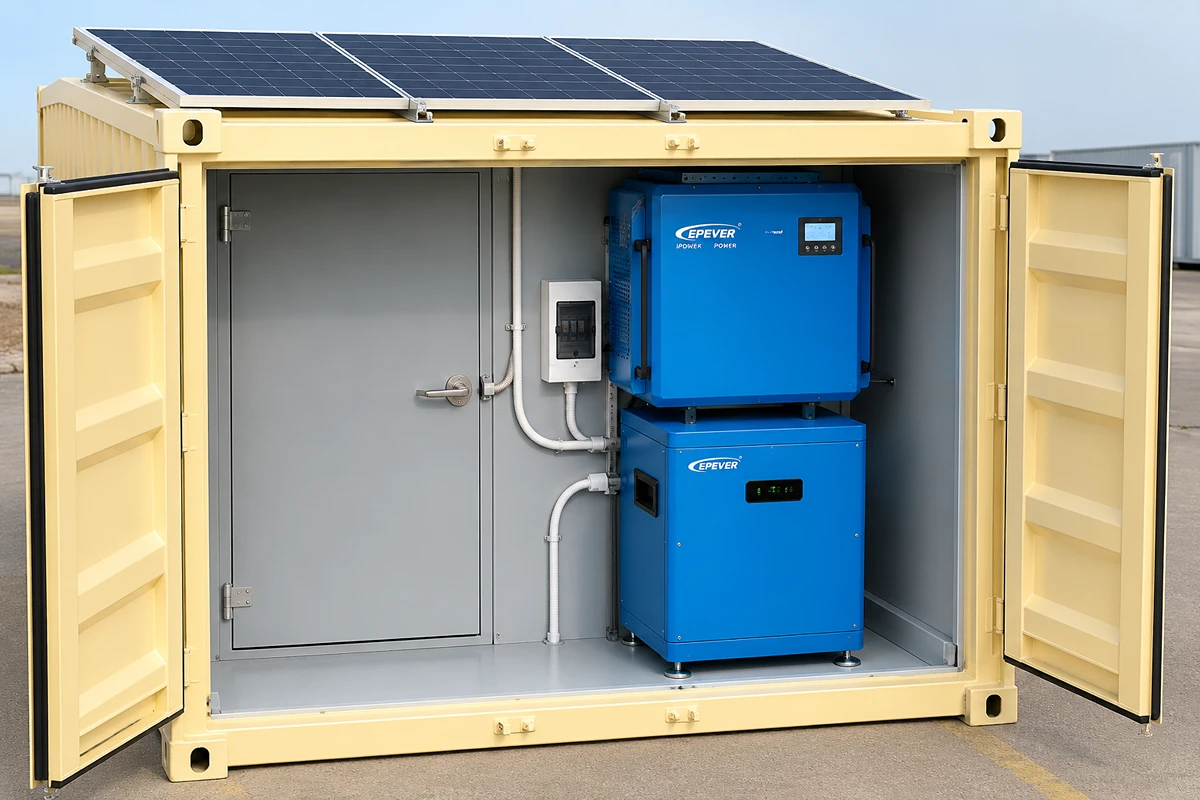
Une chambre froide autonome en énergie solaire grâce à un conteneur — des panneaux photovoltaïques, un stockage par batterie et un onduleur permettent d'assurer la réfrigération sur des sites dépourvus d'alimentation électrique fiable.
À qui s'adresse une chambre froide pour conteneurs ?
Une chambre froide conteneurisée est la solution idéale lorsque la rapidité, la mobilité ou la complexité du site empêchent l'installation d'une chambre froide intégrée. Utilisateurs types :
- ports de pêche et sites de débarquement — un entrepôt frigorifique placé précisément à l'endroit où les prises arrivent, et déplacé si l'exploitation change.
- Exploitations agricoles et acheteurs de produits agricoles — refroidissement en bordure de champ lors des pics de récolte, puis déplacement pour la saison suivante.
- Événements, projets et interventions d'urgence — mise en service d'un entrepôt frigorifique temporaire quelques heures après l'arrivée.
- Sites isolés et hors réseau — où la version solaire apporte la réfrigération à des endroits dépourvus d'électricité fiable.
- Les entreprises qui souhaitent démarrer petit — une chambre froide complète sans les contraintes de construction.
Que faut-il vérifier avant de commander ?
Quel que soit le fournisseur, ce sont ces spécifications qui détermineront si l'appareil fonctionnera effectivement sur votre site.
| Spécification | Pourquoi c'est important | VIKKINS |
| Alimentation électrique | La tension (220 V / 380 V) et la fréquence (50 Hz / 60 Hz) varient selon les pays. Des spécifications incorrectes peuvent entraîner un recâblage à la réception ou un dysfonctionnement permanent de l'appareil. | Fabriqué selon les capacités de production de votre pays — veuillez le préciser lors de votre commande. |
| température ambiante maximale | Un appareil conçu pour une température de fonctionnement de 35 °C peut perdre un tiers de sa capacité à 43 °C, et la température de l'air entrant dans le condenseur est souvent de 10 à 18 °C supérieure aux prévisions météorologiques. | Groupe de condensation sélectionné pour la consommation de pointe de votre site, et non pour des conditions de test standard. |
| Épaisseur du panneau | 120 mm est nécessaire pour un réfrigérateur. Un congélateur nécessite 150 à 200 mm. | Dimensionné selon votre température cible, et non selon notre stock. |
| Réfrigérant | Le R404A possède un potentiel de réchauffement global (PRG) de 3 922 et son utilisation est déjà restreinte dans les nouveaux équipements au sein de l’UE, du Canada et de la Californie. Le quota de l’UE passera à 51 TP3 T de référence en 2030, et l’amendement de Kigali engage les économies développées à réduire leurs émissions d’HFC de 851 TP3 T d’ici 2036. Acheter aujourd’hui un réfrigérant à PRG élevé peut impliquer des travaux de conversion ultérieurs. | Spécifié par projet et par marché de destination — indiquez-nous le pays et nous vous confirmerons la conformité. |
| État du conteneur | Neuf ou d'occasion, cela influe à la fois sur le prix et la durée de vie. | Spécifié dans la commande |
| Étage et accès | Un transpalette peut-il y accéder ? Une rampe est-elle prévue ? Le plancher d'un conteneur est généralement conçu pour supporter une charge d'environ 1,5 t/m² répartie, et le plancher isolé repose par-dessus. | L'épaisseur du plancher, la charge nominale, la largeur de la rampe et de la porte ont été confirmées au stade de la conception. |
| Délai de mise en œuvre | De la confirmation de commande à la préparation pour l'expédition | Confirmé au devis |
| Garantie, pièces détachées et service après-vente | C'est celui qui compte le plus sur un site isolé. Une panne de compresseur sur un site d'atterrissage sans pièces détachées locales peut immobiliser l'unité pendant des semaines. | Les conditions de garantie et un kit de pièces détachées recommandé sont fournis avec l'appareil ; assistance technique à distance en anglais, espagnol ou français. |
| Certification | Système de qualité de fabrication et conformité de l'emballage frigorifique | Fabrication certifiée ISO 9001 ; marquage CE disponible sur demande ; inspection par un organisme tiers (SGS, BV, Intertek) bienvenue avant expédition |
Un autre point important, souvent négligé : car une chambre froide pour conteneurs est Dans un conteneur, le transport s'effectue par voie maritime ordinaire (sans manutention spéciale ni autorisation de transport exceptionnel), à condition que le groupe frigorifique respecte les dimensions du conteneur ISO. Un groupe installé sur le toit et dépassant les dimensions du conteneur est considéré comme hors gabarit ; il est donc impératif de vérifier le mode de montage avant de réserver le transport.
Questions fréquemment posées
Qu'est-ce qu'une chambre froide pour conteneurs ?
Il s'agit d'une chambre froide entièrement équipée, aménagée dans un conteneur maritime de 20 ou 40 pieds, isolée par des panneaux sandwich, dotée de son propre groupe frigorifique, d'une porte et de commandes, et livrée prête à l'emploi. Elle allie la maîtrise de la température d'une véritable chambre froide à la mobilité et à la robustesse d'un conteneur maritime.
Quelle est la différence entre une chambre froide conteneurisée et un conteneur frigorifique ?
Un conteneur frigorifique est un conteneur maritime réfrigéré conçu principalement pour maintenir les marchandises au froid pendant le transport. Une chambre froide conteneurisée est un entrepôt frigorifique utilisant un conteneur comme enveloppe, équipé d'une isolation renforcée et d'un groupe frigorifique dimensionné pour le stockage stationnaire. L'un est conçu pour le transport de marchandises, l'autre pour leur stockage.
Quelle quantité de marchandises peut stocker un conteneur frigorifique ?
La capacité est déterminée par la taille du conteneur : environ 10 tonnes pour un conteneur de 20 pieds et 20 tonnes pour un conteneur de 40 pieds, selon le produit et son mode de stockage. Notez que le volume utile est inférieur aux dimensions intérieures du conteneur, car le revêtement isolant occupe de l'espace : environ 26 m³ pour un conteneur de 20 pieds avec un panneau de 120 mm, contre 33 m³ pour le conteneur nu. Pour des besoins plus importants, plusieurs conteneurs peuvent être utilisés, ou une chambre froide intégrée peut s'avérer plus adaptée.
Quelle épaisseur de panneau est nécessaire pour une chambre froide conteneurisée ?
Cela dépend de la température à maintenir. Pour un refroidisseur fonctionnant entre 0 et +4 °C, on utilise généralement un panneau PIR de 100 à 120 mm ; pour un congélateur fonctionnant entre -18 et -25 °C, il en faut généralement un de 150 à 200 mm. Un panneau de 120 mm annoncé pour un congélateur mérite réflexion : il maintiendra mal la température et son coût d'utilisation sera plus élevé sur toute la durée de vie de l'appareil.
Une chambre froide conteneurisée est-elle adaptée aux climats chauds ?
Oui, à condition que le groupe frigorifique soit dimensionné pour l'air qu'il respire réellement et non pour des conditions de test standard. Les puissances indiquées dans les catalogues sont publiées pour une température de 32 à 35 °C, et un groupe de 10 kW à 35 °C peut ne fournir que 6 à 7 kW à 43 °C. L'air entrant dans le condenseur est généralement de 10 à 18 °C plus chaud que la température ambiante locale, en raison du rayonnement du toit et de l'emplacement abrité. Indiquez-nous la température ambiante maximale à votre emplacement et le groupe sera dimensionné en conséquence.
De quelle quantité d'énergie solaire a besoin une chambre froide conteneurisée ?
Pour une unité de 6 mètres (20 pieds) en climat tropical, un refroidisseur consomme généralement entre 12 et 18 kWh par jour et nécessite environ 5 à 7 kWc de panneaux photovoltaïques avec une batterie de 20 à 30 kWh ; un congélateur consomme entre 28 et 38 kWh par jour et nécessite environ 10 à 14 kWc avec une batterie de 45 à 60 kWh. Il est à noter que le toit d'un conteneur de 6 mètres (20 pieds) supporte au maximum environ 3 kWc ; le système photovoltaïque s'étend donc généralement au-delà du conteneur, sur un auvent ou une structure au sol. Le dimensionnement final dépend de votre produit, du débit, de la fréquence d'ouverture des portes et de l'ensoleillement local.
Une chambre froide conteneurisée peut-elle fonctionner sans alimentation électrique secteur ?
Oui. Une chambre froide autonome en énergie solaire utilise un champ photovoltaïque, un onduleur-contrôleur et un parc de batteries pour fonctionner avec peu ou pas d'électricité du réseau, avec un générateur diesel en option en cas de besoin – ce qui la rend adaptée aux endroits isolés ou mal desservis par le réseau électrique.
En combien de temps une chambre froide conteneurisée peut-elle être utilisée ?
Livrée entièrement équipée, la chambre froide conteneurisée est opérationnelle dès sa réception : elle nécessite uniquement une base plane et un raccordement électrique, sans montage sur site. Prévoyez un temps de refroidissement avant le chargement des produits : un refroidisseur atteint sa température de consigne en quelques heures, un congélateur plus longtemps.
La plupart des fournisseurs de chambres froides pour conteneurs achètent leurs panneaux. Nous, nous les fabriquons.
Dans une chambre froide à conteneurs, l'isolation est Le produit détermine si l'appareil maintient la température, son coût de fonctionnement mensuel et la durée de vie des panneaux avant leur décollement. Le reste (l'enveloppe, la porte, le câblage) est relativement simple.
La plupart des fournisseurs se chargent de l'assemblage. Ils achètent les panneaux auprès d'un tiers, les chargent dans un conteneur, y fixent un groupe frigorifique et l'expédient. Si la densité du noyau est de 34 kg/m³ au lieu des 40 annoncés, ils l'ignorent – et vous aussi – jusqu'à la troisième année, lorsque les panneaux commencent à se déformer.
VIKKINS fabrique les panneaux : environ 5 millions de m² par an sur deux sites de production. Cela change trois choses.
- La densité du noyau est vérifiée, non revendiquée. Nous contrôlons la chaîne de production du panneau et nous acceptons les inspections par un tiers avant expédition.
- L'épaisseur est choisie en fonction de votre application, et non de notre stock. Un congélateur reçoit des panneaux de congélation.
- Une seule partie est responsable. En cas de panne, ni le fournisseur de panneaux ni l'assembleur ne se renvoient la balle.
Le contrat et le paiement sont gérés par notre bureau de Montréal – aucun virement direct vers la Chine n’est requis.
Comment VIKKINS vous aide
Chez VIKKINS, nous construisons des chambres froides conteneurisées de 20 et 40 pieds – versions réfrigérée, congélateur, à double usage et solaire autonome – livrées complètes, prêtes à l'emploi, prêtes pour le transport maritime et fournies avec le conteneur. Tout est conçu sur mesure pour votre produit et la température cible, et fabriqué en ISO 9001Nos installations certifiées, coordonnées par notre bureau de Montréal, assurent la livraison dans plus de 90 pays. Si une chambre froide conteneurisée ne convient pas, nous proposons également des chambres froides modulaires préfabriquées de toutes dimensions – consultez notre catalogue. gamme de chambres froides modulaires à comparer.
Construisons quelque chose ensemble
Indiquez-nous votre emplacement, votre produit, la température cible et la température ambiante maximale : nous vous recommanderons la chambre froide adaptée et vous enverrons une conception préliminaire sous 24 heures. Service disponible en anglais, espagnol et français.