




Home / Product knowledge / What Is a Container Cold Room?
If you need cold storage but can’t — or don’t want to — build a fixed room on site, a container cold room is often the fastest way to get there. It arrives as a complete, ready-to-run cold room built inside a shipping container: plug it in, and you have a working chiller or freezer the same day. But “container cold room” means different things to different suppliers, and choosing the right type matters. This guide explains what a container cold room actually is, how it differs from a traditional built-in cold room and from a reefer shipping container, and how to decide whether it fits your operation.
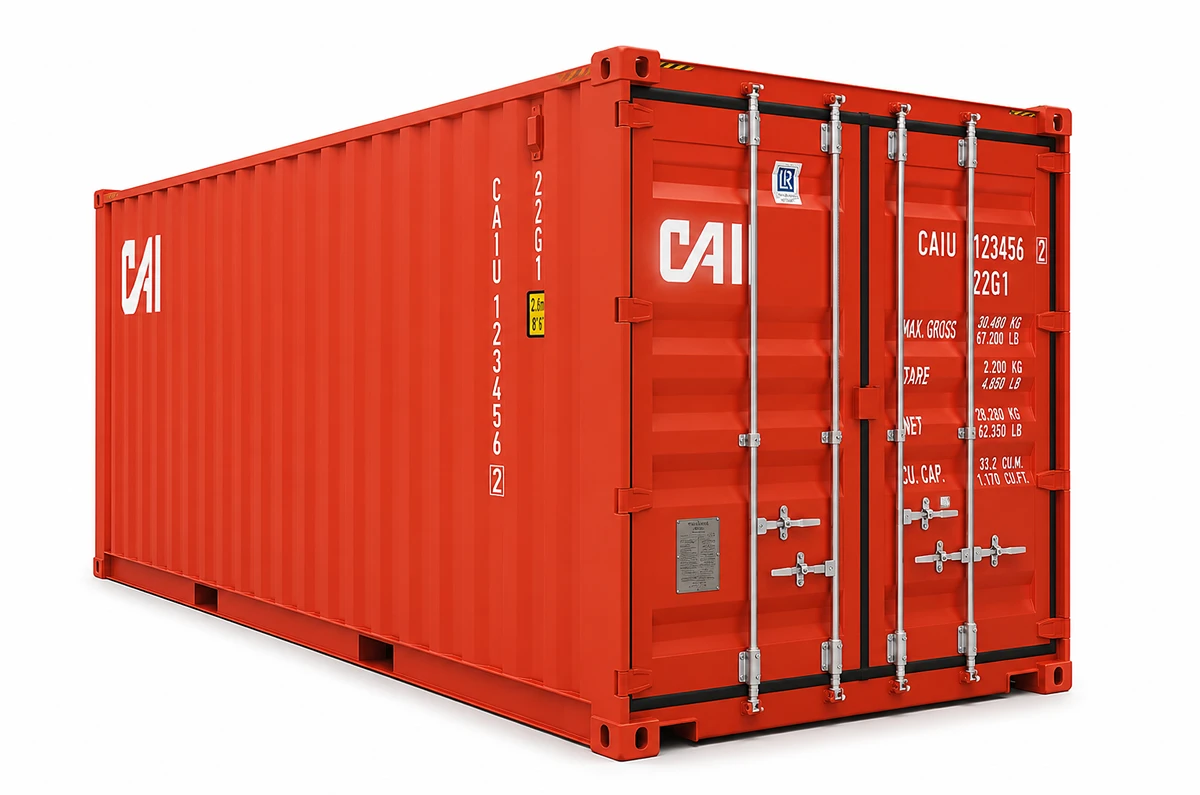
A 20ft container cold room — a complete walk-in cold room in a rugged, transportable steel shell.
What is a container cold room?
A container cold room is a self-contained cold storage unit built into a standard 20ft or 40ft shipping container. The container is lined with insulated sandwich panels and fitted with its own refrigeration unit, door and controls, so the whole thing works as a complete walk-in cold room — but one that can be craned onto a truck and moved. You get the insulation and temperature control of a proper cold room, in a rugged, weatherproof, transportable steel shell.
The key point: it ships as a finished product. Unlike a built-on-site cold room that arrives as a kit of panels to assemble, a container cold room leaves the factory complete — insulated, refrigerated and wired — and is ready to operate as soon as it reaches the site and gets power.
Container cold room vs a reefer container — an important distinction
These two are often confused, and the difference matters when you buy. A reefer is a refrigerated shipping container, designed mainly to keep cargo cold while it travels by sea or road. A container cold room is a storage cold room that happens to use a container as its shell — engineered to hold a stable temperature as a stationary walk-in room, with proper insulated panels and a cold-room-grade refrigeration unit.
In short: a reefer is built to move goods; a container cold room is built to store them. If your goal is on-site cold storage rather than transport, a purpose-built container cold room gives you better insulation, easier access and refrigeration matched to storage duty.
Container cold room, reefer or built-in room — the honest comparison
In practice you are choosing between three things, not two. Here is how they differ:
| Factor | Container cold room | Reefer container | Traditional built-in cold room |
| Designed for | Stationary storage | Cargo in transit | Stationary storage |
| Insulation | 100–200 mm PIR, thickness sized to duty | Typically around 60–90 mm, fixed | Sized to duty |
| Deployment | Delivered complete, running the same day it’s powered | Delivered complete | Built or assembled on site over days |
| Mobility | Craned and relocated whenever the work moves | Fully mobile | Permanent — can’t be moved once built |
| Site works | Minimal — a level base and a power supply | Minimal | Foundation, assembly and fit-out required |
| Access | Cold-room door, walk-in layout | Cargo doors at one end, T-bar floor | Custom |
| Capacity | Roughly 10 t in 20ft, 20 t in 40ft | Similar shell, less usable volume once transit airflow clearances are kept | Custom — from small rooms to large warehouses |
| Best for | Fast, flexible, movable or remote cold storage | Moving goods | Large, permanent, fixed-location storage |
None of the three is universally better. A container cold room wins on speed, mobility and simplicity. A reefer wins when the goods themselves have to travel. A built-in room wins when you need large, permanent capacity in one fixed place.
How a container cold room is built
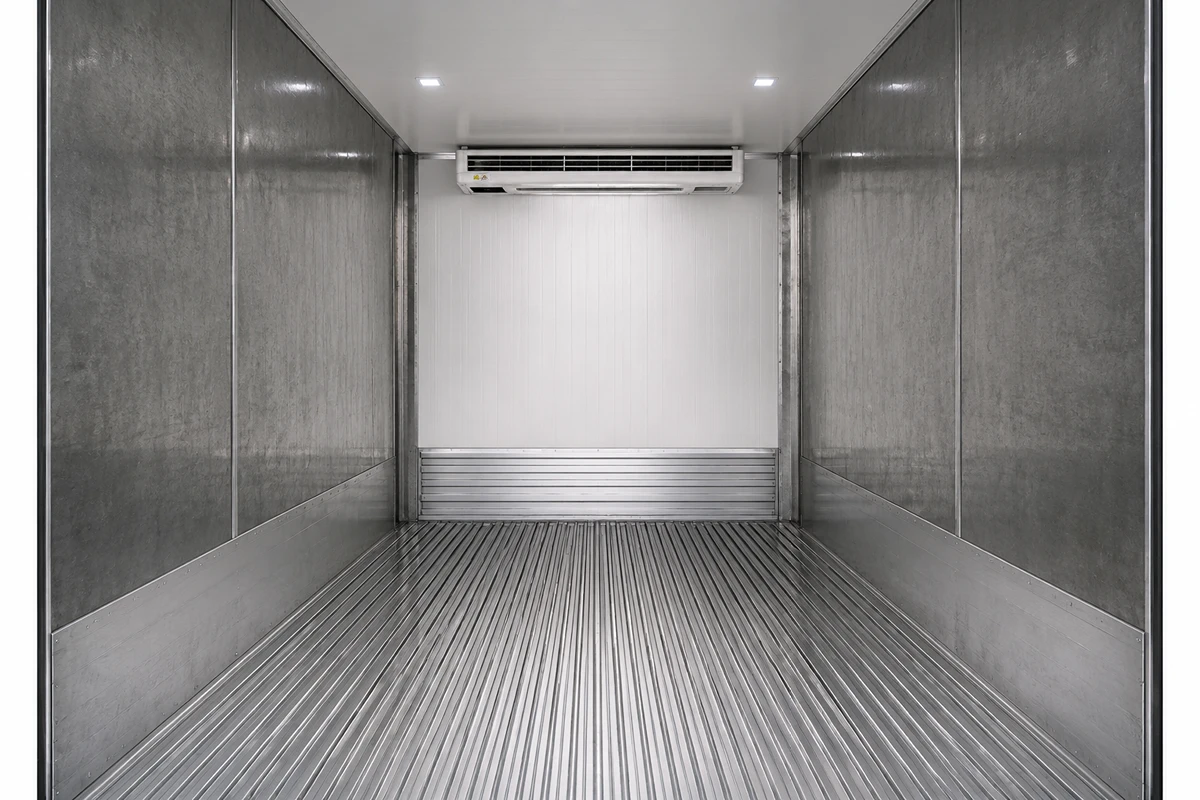
Inside, it’s a real cold room — insulated panels, an evaporator and a proper floor, not just a lined box.
Inside the steel container shell, a container cold room is a real cold room, engineered to the same principles as any quality cold storage:
- Insulated panels. The container is lined with PIR sandwich panels at around 40 kg/m³ core density, with a thermal conductivity of roughly 0.022 W/(m·K). Thickness is sized to your target temperature, not fixed:
- Chiller duty (0 to +4 °C): 100–120 mm
- Freezer duty (−18 to −25 °C): 150–200 mm
Insulation is what keeps the temperature stable and the running cost down — the single biggest factor in a cold room’s energy bill, and the most common place a cheap unit cuts corners. If a supplier quotes 120 mm panel for −20 °C duty, ask them why.
- An integrated refrigeration unit. A plug-and-play inverter unit matched to your target temperature and to your site’s ambient temperature. Inverter (variable-frequency) control holds temperature tightly and uses noticeably less energy than fixed-speed running.Ambient rating is the specification buyers most often skip, and it is the one that quietly decides whether the unit works. Catalogue capacities are usually published at 32 °C or 35 °C. A unit rated at 10 kW at 35 °C may deliver only 6–7 kW at 43 °C — a loss of a third or more, exactly when you need it most.
Worse, the number that matters is not the weather forecast. It is the air actually entering the condenser, which on a sun-baked container roof or in a sheltered corner can run 10–18 °C above the nearest weather-station reading. A 32 °C town can present 42 °C air to the condenser.
Where a site needs it, high-ambient configurations with enlarged condenser coils are used instead of the standard build. Tell us your site’s peak temperature and how the unit will be positioned, and we size it for the air it will actually breathe.
- A cold room door and accessories. A proper insulated door, evaporator, lighting, cabling and pressure-balance vents — everything a walk-in room needs, pre-fitted.
- The container itself. A standard 20GP or 40GP container gives a rugged, weatherproof, stackable, sea-ready shell that protects the room in transit and in service.
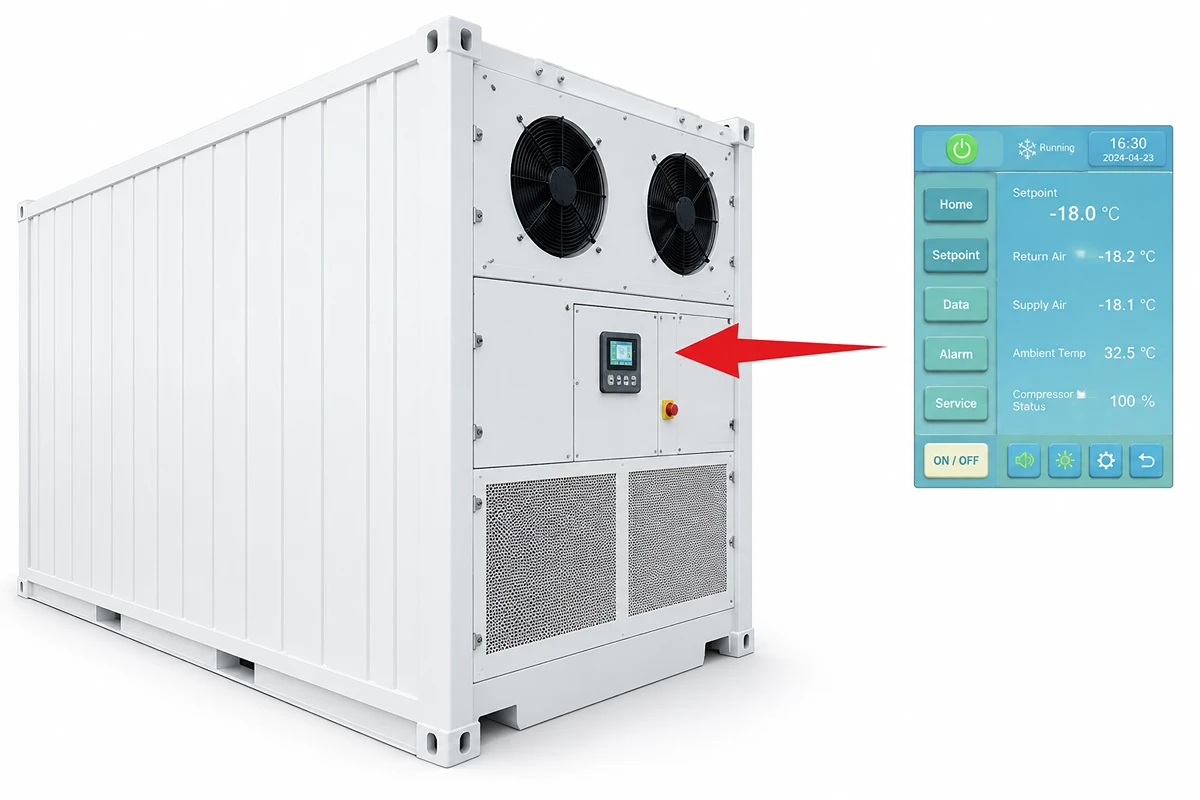
A plug-and-play inverter refrigeration unit — matched to the target temperature and delivered pre-fitted.
Types of container cold room
Container cold rooms are not one product. The main variations are:
- 20ft (around 10 t) and 40ft (around 20 t). The two standard footprints. One thing worth knowing before you order: the container’s internal dimensions and the finished cold room’s usable dimensions are not the same. The insulated lining takes up space.
20ft 40ft Container internal 5.90 × 2.35 × 2.39 m (≈33 m³) 12.03 × 2.35 × 2.39 m (≈68 m³) Usable cold room, 120 mm panel ≈5.66 × 2.11 × 2.15 m (≈26 m³) ≈11.79 × 2.11 × 2.15 m (≈53 m³) That is roughly a fifth of the volume lost to insulation, and thicker freezer panels take more. We give you both figures at quotation stage, so there are no surprises on the day it lands.
- Chiller or freezer. Configured to your temperature — for example around −20 to +2 °C for a freezer/chiller duty — with panel thickness and refrigeration sized to suit. Dual-purpose freezer/refrigerator versions can switch duty.
- Off-grid solar container cold room. This is the one that changes the game for remote and unreliable-grid locations. A container cold room paired with a solar PV array, an inverter-controller and a LiFePO4 battery bank runs with little or no mains power — with an optional diesel generator as backup. For fishing landing sites, farms and rural markets far from a stable grid, it means cold storage where none was possible before.Indicative sizing for a 20ft unit in tropical conditions, designed against the worst solar month:
Chiller (0 to +4 °C) Freezer (−18 to −25 °C) Daily consumption 12–18 kWh/day 28–38 kWh/day PV array 5–7 kWp 10–14 kWp Battery bank (LiFePO4) 20–30 kWh 45–60 kWh Autonomy without sun 1 day as standard; 2 days optional One practical point most suppliers leave out: the array will not fit on the container roof. A 20ft roof is about 14.8 m², which holds at most around 3 kWp of modern modules — less once mounting rails and access are allowed for. A chiller therefore needs a canopy roughly twice the container’s footprint; a freezer needs a ground-mounted or extended structure three to four times the roof area. Plan the site for that, not for a neat rooftop installation.
Ranges above assume moderate daily throughput and a design ambient of 35 °C. Higher intake, frequent door openings, or hotter sites move the numbers up. We size the array and battery from your actual duty cycle, and if the numbers don’t work for your location we will say so before you order rather than after.
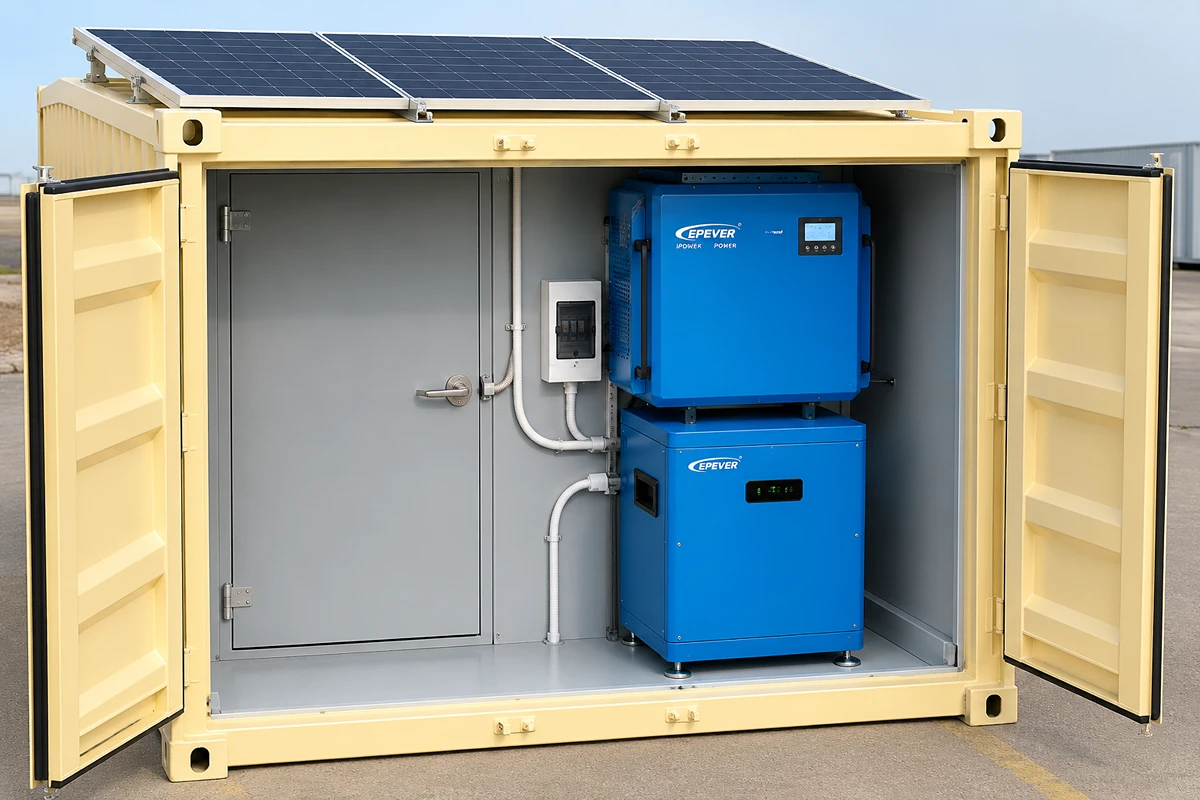
An off-grid solar container cold room — PV, battery storage and an inverter bring refrigeration to sites with no reliable power.
Who a container cold room is for
A container cold room is the right answer when speed, mobility or a difficult site rule out a built-in room. Typical users:
- Fishing ports and landing sites — cold storage placed exactly where the catch comes in, and moved if the operation moves.
- Farms and produce buyers — cooling at the field edge during harvest peaks, then relocated for the next season.
- Events, projects and emergency response — temporary cold storage running within hours of arrival.
- Remote and off-grid sites — where the solar version brings refrigeration to places with no reliable power.
- Businesses that want to start small — a complete cold room without the commitment of building one.
What to confirm before you order
Whoever you buy from, these are the specifications that decide whether the unit actually works on your site.
| Specification | Why it matters | VIKKINS |
| Power supply | 220 V / 380 V and 50 Hz / 60 Hz vary by country. The wrong spec means rewiring on arrival, or a unit that never runs right | Built to your country’s supply — specify at order |
| Peak ambient temperature | A unit rated at 35 °C can lose a third of its capacity at 43 °C, and condenser inlet air often runs 10–18 °C above the weather forecast | Condensing unit selected for your site’s peak, not for a catalogue test condition |
| Panel thickness | 120 mm is chiller duty. Freezer duty needs 150–200 mm | Sized to your target temperature, not to our stock |
| Refrigerant | R404A has a GWP of 3,922 and is already restricted in new equipment in the EU, Canada and California. The EU quota falls to 5% of baseline in 2030, and the Kigali Amendment commits developed economies to an 85% HFC cut by 2036. Buying high-GWP today can mean a retrofit later | Specified per project and per destination market — tell us the country and we confirm what is compliant there |
| Container condition | New or used changes both price and service life | Specified at order |
| Floor and access | Can a pallet truck get in? Is a ramp included? A container deck is generally worked to around 1.5 t/m² distributed, and the insulated floor build-up sits on top of that | Floor build-up, rated loading, ramp and door width confirmed at design stage |
| Lead time | From order confirmation to ready for shipment | Confirmed at quotation |
| Warranty, spare parts and service | This is the one that matters most on a remote site. A compressor failure at a landing site with no local parts can idle the unit for weeks | Warranty terms and a recommended spare-parts kit are quoted with the unit; remote technical support in English, Spanish or French |
| Certification | Manufacturing quality system, and conformity for the refrigeration package | ISO 9001 manufacturing; CE available on request; third-party inspection (SGS, BV, Intertek) welcome before shipment |
One more point that is easy to miss: because a container cold room is a container, it ships as ordinary ocean freight — no special handling and no oversize permits — provided the refrigeration unit sits within the ISO envelope. A roof-mounted unit that breaks the container profile becomes out-of-gauge cargo, so confirm the mounting arrangement before you book freight.
Frequently asked questions
What is a container cold room?
It’s a complete walk-in cold room built inside a 20ft or 40ft shipping container — insulated with sandwich panels, fitted with its own refrigeration unit, door and controls, and delivered ready to run. It combines the temperature control of a proper cold room with the mobility and toughness of a shipping container.
What is the difference between a container cold room and a reefer container?
A reefer is a refrigerated shipping container built mainly to keep cargo cold in transit. A container cold room is a storage cold room that uses a container as its shell, engineered with cold-room insulation and a refrigeration unit sized for stationary storage. One is built to move goods; the other to store them.
How much can a container cold room store?
Capacity is set by the container size — roughly 10 tonnes in a 20ft unit and 20 tonnes in a 40ft unit, depending on the product and how it’s stacked. Note that usable internal volume is smaller than the container’s own internal dimensions, because the insulated lining takes up space: about 26 m³ in a 20ft unit with 120 mm panel, against 33 m³ for the bare container. For larger needs, multiple units can be used, or a built-in cold room may suit better.
What panel thickness does a container cold room need?
It depends on the temperature you need to hold. Chiller duty at 0 to +4 °C typically uses 100–120 mm PIR; freezer duty at −18 to −25 °C typically needs 150–200 mm. A 120 mm panel quoted for freezer duty is worth questioning — it will hold temperature poorly and cost more to run for the life of the unit.
Will a container cold room work in a hot climate?
Yes, provided the refrigeration unit is rated for the air it will actually breathe rather than a standard test condition. Catalogue capacities are published at 32–35 °C, and a unit rated at 10 kW at 35 °C may deliver only 6–7 kW at 43 °C. Condenser inlet air is also commonly 10–18 °C hotter than the local weather reading, because of roof radiation and sheltered positioning. Tell us the peak ambient at your location and the unit is specified for it.
How much solar does a container cold room need?
For a 20ft unit in tropical conditions, a chiller typically uses 12–18 kWh a day and needs roughly 5–7 kWp of PV with a 20–30 kWh battery; a freezer uses 28–38 kWh a day and needs roughly 10–14 kWp with 45–60 kWh of battery. Note that a 20ft container roof holds at most about 3 kWp, so the array normally extends beyond the container on a canopy or ground-mounted frame. Final sizing depends on your product, throughput, door-opening frequency and local irradiance.
Can a container cold room run without mains power?
Yes. An off-grid solar container cold room uses a PV array, an inverter-controller and a battery bank to run with little or no grid power, with an optional diesel generator as backup — making it suitable for remote or unreliable-grid locations.
How quickly can a container cold room be used?
Because it’s delivered complete, a container cold room can be operating the same day it arrives — it needs only a level base and a power connection, with no on-site assembly. Allow pull-down time before loading product: a chiller reaches setpoint in a few hours, a freezer takes longer.
Most container cold room suppliers buy their panels. We make ours.
In a container cold room, the insulation is the product. It decides whether the unit holds temperature, what it costs to run every month, and how many years pass before the panels start to delaminate. Everything else — the shell, the door, the wiring — is comparatively easy.
Most suppliers assemble. They buy panels from a third party, line a container, bolt on a refrigeration unit and ship it. If the core density is 34 kg/m³ instead of the 40 that was quoted, they don’t know — and neither do you, until year three when the panels begin to bubble.
VIKKINS manufactures the panels: around 5 million m² a year across two production bases. That changes three things.
- Core density is verified, not claimed. We control the line the panel comes off, and we welcome third-party inspection before shipment.
- Thickness is chosen for your duty, not for our stock. A freezer gets freezer panels.
- One party is accountable. There is no panel supplier and assembler pointing at each other when something fails.
Contract and payment run through our Montréal office — no direct transfer to China required.
How VIKKINS helps
At VIKKINS we build container cold rooms in 20ft and 40ft sizes — chiller, freezer, dual-purpose and off-grid solar versions — each delivered as a complete, plug-and-play unit, sea-ready and supplied with the container. Everything is engineered to your product and target temperature and manufactured in ISO 9001-certified facilities, coordinated through our Montréal office for delivery to 90+ countries. If a container cold room isn’t the right format, we also build flat-pack modular cold rooms in any size — see our modular cold room range to compare.
Let’s build something together
Tell us your location, product, target temperature and peak ambient — we’ll recommend the right container cold room and send a preliminary design within 24 hours. Service in English, Spanish, or French.