




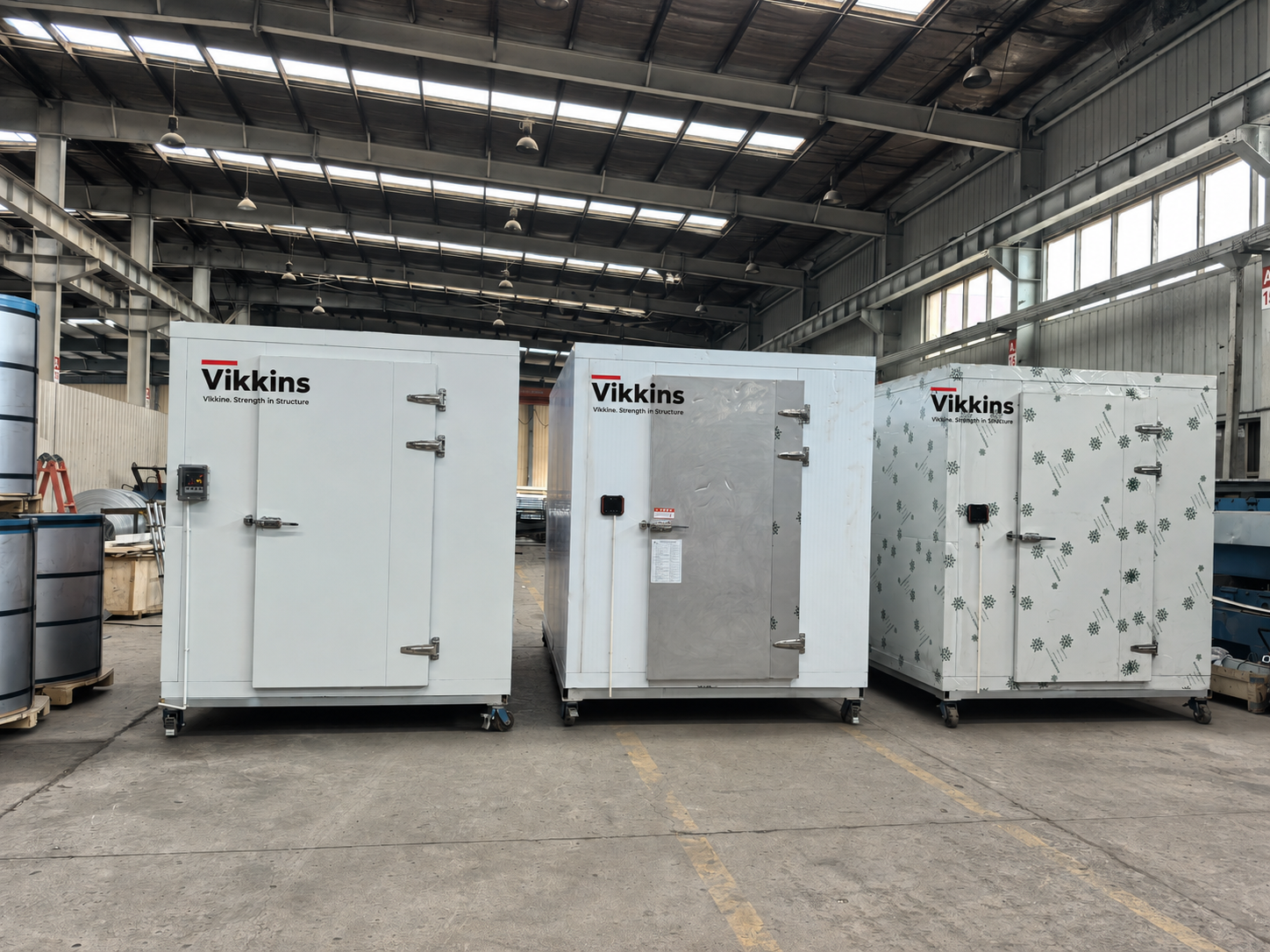
Blast freezer panel thickness is the first irreversible decision in a cold store project, and it usually arrives as two quotations on the desk for the same 20 × 15 × 5 m room. One specifies 100 mm panels. The other specifies 150 mm. The second is roughly 30% more expensive on the envelope line.The other specifies 150 mm. The second is roughly 30% more expensive on the envelope line.
The supplier offering 100 mm says it is “standard for freezer rooms.” The supplier offering 150 mm says the thinner panel “will not hold −35°C.” Both sound confident. Neither has shown you a calculation.
There is a calculation, it takes about ten minutes, and it settles the question. More importantly, it exposes the assumption behind most of the expensive mistakes in this category: that a blast freezer is simply a cold room set to a lower number.
It is not. And the difference is not a matter of degree.
The only two formulas you need
Heat moves through a panel at a rate governed by one property: thermal conductivity, written as λ (lambda), in W/(m·K). Every insulation core has one. Divide it by the panel thickness and you get the U-value — the heat that passes through one square metre for every degree of temperature difference:
U = λ / d
U in W/(m²·K) · λ in W/(m·K) · d = core thickness in metres
Then the heat flux through that panel is:
q = U × ΔT
q in W/m² · ΔT = temperature difference across the panel, in kelvin
That is the whole basis of panel selection. Everything else is applying it honestly.
Declared thermal conductivity values, per the European product standards for each core type:
| Core material | Declared λ, W/(m·K) | Product standard |
|---|---|---|
| PIR (polyisocyanurate) | 0.022 – 0.026 | EN 13165 |
| PU (polyurethane) | 0.023 – 0.028 | EN 13165 |
| EPS (expanded polystyrene) | 0.033 – 0.038 | EN 13163 |
| Mineral wool | 0.038 – 0.045 | EN 13162 |
One question worth asking every supplier: is the quoted λ the initial value or the aged value? Closed-cell foams change over time as the blowing agent diffuses out. EN 13165 requires a declared value that accounts for ageing, but not every datasheet in circulation follows it. For a building with a twenty-year life, the aged figure is the one that matters. The worked examples below use 0.022 W/(m·K) — the favourable end of the PIR range — so that the conclusions hold even for a good panel.
Why −35°C changes the arithmetic, not just the setpoint
Take a plant in a tropical or subtropical location. Design ambient 30°C.
- Frozen store at −18°C: ΔT = 48 K
- Blast freezer at −35°C: ΔT = 65 K
That is 35% more temperature difference across the same wall. Since heat flux is directly proportional to ΔT, the identical panel leaks 35% more heat the moment you drop the setpoint from −18°C to −35°C.
Run it through with 100 mm PIR — U = 0.022 / 0.10 = 0.220 W/(m²·K):
| نوع الغرفة | ΔT | Heat flux q |
|---|---|---|
| −18°C store | 48 K | 10.6 W/m² |
| −35°C blast freezer | 65 K | 14.3 W/m² |
Now the reverse question, which is the one that actually decides the purchase. If 150 mm PIR gives an acceptable 7.0 W/m² in the −18°C store, what thickness gives that same 7.0 W/m² at −35°C?
U required = 7.0 / 65 = 0.108 W/(m²·K)
d required = 0.022 / 0.108 = 0.204 m → ٢٠٠ ملم
So the honest answer to those two quotations is that neither 100 mm nor 150 mm delivers, at −35°C, what 150 mm delivers in a conventional freezer store. Holding the same envelope performance at blast-freezing temperature takes roughly one thickness step more than most buyers expect — because they are anchored to their experience with −18°C rooms.
Doubling the thickness does not halve the loss
This is where intuition fails most often, and where money gets wasted at the other extreme.
U is inversely proportional to thickness, so going from 100 mm to 200 mm does halve the conduction through the panel. But conduction through the panel is only one component of the total refrigeration load. The others do not care how thick your walls are:
- Product load — the enthalpy you must remove from the goods themselves. In a blast freezer this is the dominant load by design; it is the entire purpose of the room.
- Infiltration — air exchanged every time the door opens. At −35°C, each door cycle admits humid air that must be cooled, dried, and its moisture frozen out.
- Fans — blast freezer air velocity is high by definition. Every watt of fan motor becomes a watt of heat inside the room.
- Defrost — the energy put into the coil during defrost lands in the room.
- Lighting and people.
In a typical blast freezer, envelope conduction accounts for roughly 20–30% of total load. So halving it by doubling the panel thickness reduces the المجموع refrigeration load by about 10–15% — not 50%.
This cuts both ways, and both directions cost money. Under-specifying means the plant runs a permanently oversized machine to compensate for an envelope it cannot fix, and pays for that every hour for twenty years. Over-specifying means paying for thickness whose marginal return has collapsed.
What the difference actually costs, per year
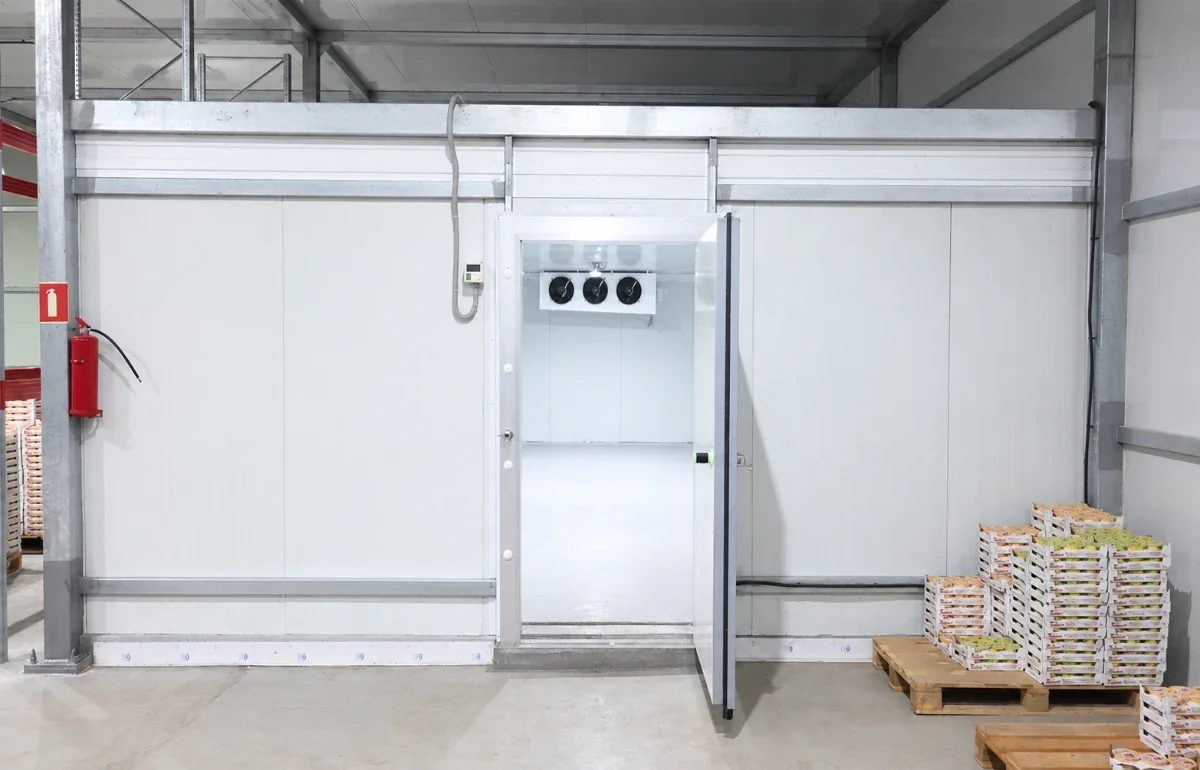
Same room: 20 × 15 × 5 m. Envelope area including floor and ceiling ≈ 950 m². Ambient 30°C, interior −35°C, ΔT = 65 K.
Assumptions stated explicitly so you can substitute your own: electricity USD 0.12 /kWh, low-temperature system COP 1.3, continuous operation 8,760 h/year.
| لوحة | U | Envelope load | Electrical | Annual energy cost |
|---|---|---|---|---|
| 100 mm PIR | 0.220 | 13.6 kW | 10.5 kW | USD 10,990 |
| 150 mm PIR | 0.147 | 9.1 kW | 7.0 kW | USD 7,360 |
| 200 mm PIR | 0.110 | 6.8 kW | 5.2 kW | USD 5,500 |
100 → 150 mm saves USD 3,630 per year. 150 → 200 mm saves USD 1,860 per year.
The first step saves nearly twice what the second step saves, for the same increment of thickness and roughly the same increment of cost. That is the diminishing return, in dollars.
You can complete the decision with the two quotations already in front of you:
Payback (years) = extra envelope cost ÷ annual energy saving
The extra envelope cost is the difference between the two quoted panel prices — a number you already have. The annual saving is the calculation above, run at your own electricity tariff. If the first thickness step pays back in under two years and the second takes four, those are two different decisions, and a quotation that does not distinguish them is not giving you the information you need.
Why 150 mm EPS is thermally worse than 100 mm PIR
Buyers comparing quotations across suppliers frequently compare سُمك rather than performance. Thickness is not performance. Run the same formula:
| لوحة | λ | U = λ / d |
|---|---|---|
| 100 mm PIR | 0.022 | 0.220 |
| 150 mm EPS | 0.036 | 0.240 |
The EPS panel is 50% thicker and still lets more heat through. To match a 100 mm PIR panel, EPS needs about 164 mm; to match 150 mm PIR it needs about 245 mm.
At −35°C there is a second reason EPS rarely belongs in a blast freezer, and it has nothing to do with λ. It is vapour.
At 30°C and 70% relative humidity outside, and −35°C inside, the vapour pressure difference across that wall is enormous and permanently one-directional: from outside in. Any water vapour that reaches the core condenses and then freezes. Ice inside an insulation core does two things — it displaces the air that was doing the insulating, and it does not leave when the season changes. λ degrades year on year, and the degradation is invisible until the plant notices its energy bill climbing and its coil frosting faster than it used to.
Closed-cell PIR and PU with impermeable facings resist this. Open-structure cores and permeable facings do not. The vapour barrier belongs on the warm side of the panel — which, in a freezer, is the outside. In tropical projects this is inverted from what crews trained on temperate buildings expect, and it is a common and expensive site error.
Three things the panel specification will not tell you
1. The joints
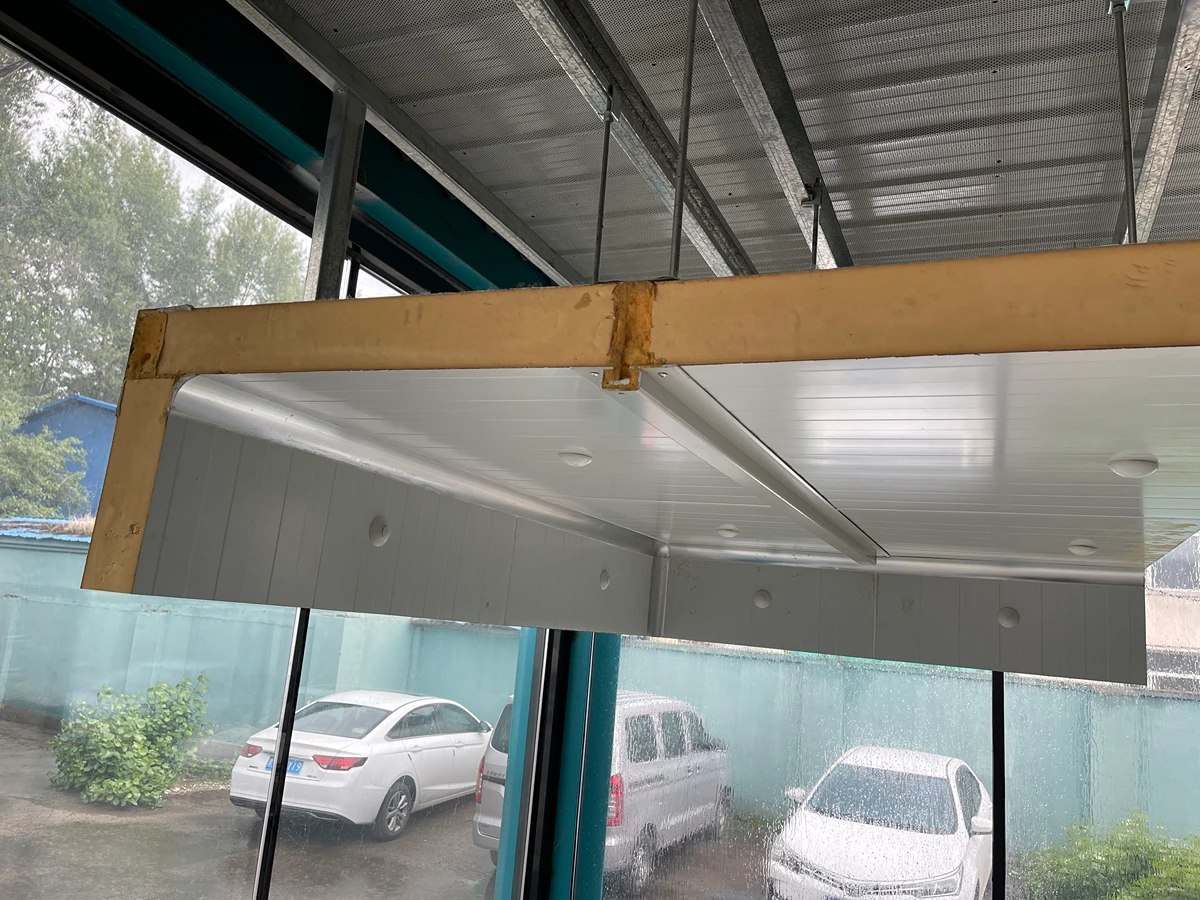
A panel’s U-value is measured through the middle of the panel. Every cam-lock joint, corner, ceiling-to-wall junction and floor detail is a potential thermal bridge. A well-designed joint with a continuous gasket and a proper thermal break typically adds 5–10% to the calculated conduction load. A poorly executed one — gaskets pinched, panels forced, sealant used as a substitute for geometry — can add 20–30%, which erases the entire benefit of the thickness step you just paid for.
Ask any supplier for the joint detail drawing before you compare prices. If two quotations specify the same core and thickness but only one shows the joint, they are not the same building. The panel system standard EN 14509 covers the tested performance of the assembled system rather than the core alone — a useful reference to name when you ask.
2. The floor
Envelope calculations routinely omit it, and the floor is typically a third of the total heat transfer area. Worse, at −35°C the floor is not only a thermal problem but a structural one. Sustained sub-zero temperature drives the freezing front down into the ground beneath the slab; the water in that soil expands as it freezes and lifts the slab. Frost heave has cracked more freezer floors than overloading ever has. The remedies — under-slab insulation, and either a heating grid or a ventilated void — must be designed in, not added later.
3. The penetrations
Refrigeration pipework, electrical conduit, drains, door frames. Each is a hole through a continuous insulated envelope, and each is a place where warm humid air meets a very cold surface. Uninsulated penetrations in a blast freezer do not merely leak heat; they grow ice, and the ice grows until something is damaged.
Four mistakes that recur
Applying chill-room experience to blast freezing. “We have used 100 mm on all our cold rooms” is true and irrelevant. Those rooms ran at 0°C to −18°C. The ΔT arithmetic above is why the same panel behaves differently.
Comparing thickness instead of U-value across quotations. Ask every supplier for λ, thickness, and the resulting U-value. If a supplier cannot or will not state λ with a test standard reference, that is itself the answer.
Buying the envelope and the refrigeration separately, with no one owning the load calculation. The panel supplier sizes to the panel spec. The refrigeration contractor sizes to the load he was given. If nobody reconciles the two, the plant discovers the gap in its first hot season.
Ignoring the vapour direction. Correct in temperate practice, inverted in a freezer, and inverted again from what many crews assume in tropical climates. Free to get right at design stage, expensive to correct afterwards.
A starting point for selection
Design ambient 30°C, PIR core at λ = 0.022, targeting comparable envelope heat flux across room types:
| نوع الغرفة | Setpoint | ΔT | Indicative PIR thickness |
|---|---|---|---|
| Chilled store | 0 to +4°C | 26–30 K | ٧٥–١٠٠ ملم |
| Frozen store | −18 to −25°C | 48–55 K | ١٥٠ ملم |
| Blast freezer | −35 to −40°C | 65–70 K | ٢٠٠ ملم |
| Ultra-low / tuna grade | −50 to −60°C | 80–90 K | 200–250 mm |
Treat this as the opening position of the calculation, not its conclusion. Ambient design temperature, humidity, door-cycle frequency, product throughput and local electricity price all move the answer, and some of them move it a long way. A plant at 45°C design ambient is answering a different question from a plant at 22°C.
What this means for how you buy
The specification that protects a project is not “150 mm sandwich panel.” It is:
- core material and declared λ, with the test standard, stated as initial or aged
- panel thickness, and the resulting U-value stated as a number
- joint detail drawing
- floor build-up including insulation and frost protection
- vapour barrier position
- penetration details
Six lines. Any supplier able to answer all six is quoting the same building as any other supplier able to answer all six, and the prices become comparable. Any supplier who cannot is quoting something else, and the difference will surface after the room is built and running.
Send us the room, we will send you the calculation
Tell us the internal dimensions, the setpoint, your design ambient temperature and humidity, and what you are freezing and at what throughput. Our engineering team will return the envelope heat load calculation, the recommended thickness with the U-value stated, the joint and floor details, and an indicative annual energy figure at your local electricity tariff.
If you already have quotations in hand, send those instead. We will tell you what the two suppliers are actually offering, in the same units.
Send us the room dimensions and setpoint — we will send back the heat load calculation.
| Request an Engineering Review | واتساب |
sales@vikkins.com · +86-139-1005-4364
متعلق
- نظام غرف التبريد
- غرفة تبريد معيارية
- Wall System — Insulated Sandwich Panels
- سلسلة التبريد ومراكز الخدمات اللوجستية
بقلم فريق الهندسة فيكينز
VIKKINS is a Canada-operated, China-manufacturing steel building company delivering cold-chain, industrial and agricultural building packages to 90+ countries. We engineer structure and envelope as a single package, so that the thermal performance specified at design stage is the thermal performance the plant actually gets.
ISO 9001:2015 · ISO 14001:2015 · ISO 45001:2018 · CE · CWB certified