



Pourquoi votre système de ventilation de poulailler tombe en panne : Ammoniac, maladies et perte de production de 15%
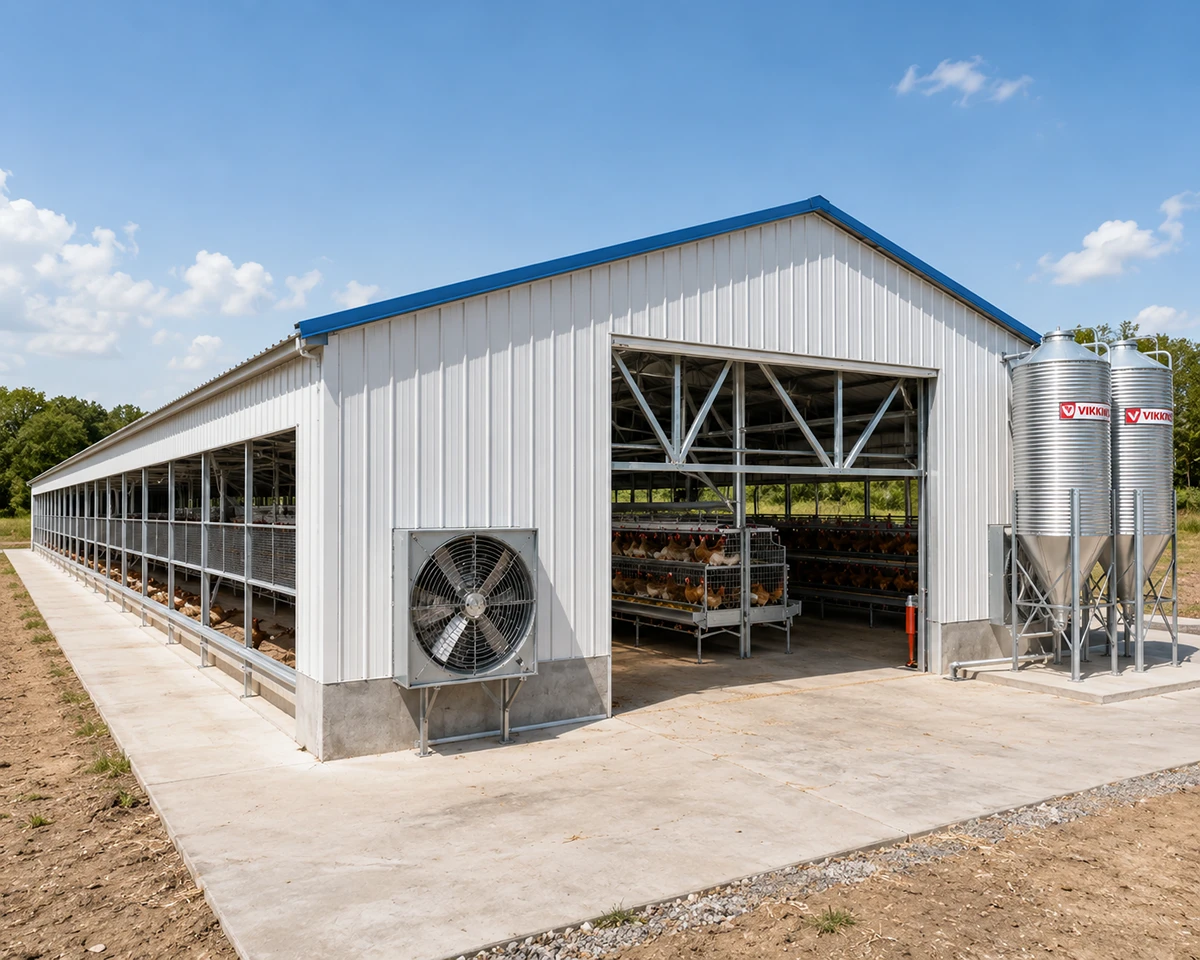
Deux élevages de poules pondeuses avec des troupeaux identiques, une alimentation identique et une gestion identique. La seule différence : l’un utilise un système de ventilation professionnel pour son poulailler.
L'élevage doté d'un système de ventilation performant pour son poulailler produit 93 œufs pour 100 poules par jour. L'autre en produit 78.
Cet écart de 15 points coûte environ à la deuxième ferme 8 400 USD de pertes de production chaque mois — plus de 140 000 USD sur un seul cycle de 72 semaines, d'une seule maison.
La différence ne réside ni dans la génétique ni dans l'alimentation. Elle est Contrôle environnemental grâce à une conception professionnelle du système de ventilation multicouche pour maisonsMaintenir la qualité de l'air, la température et l'humidité stables de la semaine 1 à la semaine 72. Ce contrôle repose non pas sur les équipements à l'intérieur du bâtiment, mais sur le bâtiment lui-même, conçu spécifiquement pour une ventilation efficace par couches.
Pourquoi la conception multicouche des systèmes de ventilation des maisons contrôle-t-elle l'ammoniac ? La science de la protection de l'environnement
L'ammoniac (NH₃) est invisible. Et au bout d'une dizaine de minutes à l'intérieur d'une maison, on cesse de le sentir — la fatigue olfactive s'installe — alors que sa concentration reste inchangée. C’est pourquoi l’ammoniac est l’un des intrants que presque personne ne mesure, même s’il détruit la production. Un système de ventilation mal conçu pour les poulaillers ne peut pas le contrôler.
Chez les oiseaux, l'ammoniac a des effets immédiats, notamment lorsque la capacité du système de ventilation du poulailler est insuffisante :
À une concentration d'ammoniac de 10 ppm : Les muqueuses respiratoires s'enflamment. Les vaisseaux sanguins se congestionnent. Un œdème apparaît au niveau des voies respiratoires supérieures de l'oiseau. Ce phénomène est asymptomatique – l'éleveur ne constate aucun signe évident de maladie – mais l'oiseau développe une réponse immunitaire à un gaz toxique.
À 20 ppm : Les surinfections bactériennes deviennent inévitables. Escherichia coli et Mycoplasma profitent de l'épithélium endommagé. Le taux de ponte commence à diminuer sensiblement (perte typique de 5 à 81 œufs).
À 50 ppm (0,05 mL/L) : Un troupeau de poules pondeuses de 80% passe à 60% en 10 jours. C'est un effondrement de la production.
À 100 ppm (0,1 mL/L) : Détresse respiratoire sévère, mortalité rapide.
Norme internationale : La concentration d'ammoniac doit rester inférieure à 10 ppm en permanence. La concentration de sulfure d'hydrogène (H₂S) doit rester inférieure à 8 ppm. La concentration de CO₂ ne doit pas dépasser 0,151 TP3T.
Pourtant, dans les élevages dont les systèmes de ventilation des poulaillers sont sous-dimensionnés ou mal conçus, la concentration d'ammoniac atteint régulièrement 30 à 50 ppm durant les mois chauds, lorsque l'humidité est élevée et que l'humidité de la litière favorise la décomposition. L'éleveur attribue alors la perte de production de la souche 20% à une maladie virale ou à la qualité de l'alimentation. Le véritable problème réside dans une ventilation insuffisante due à une conception non conforme du système de ventilation du poulailler.
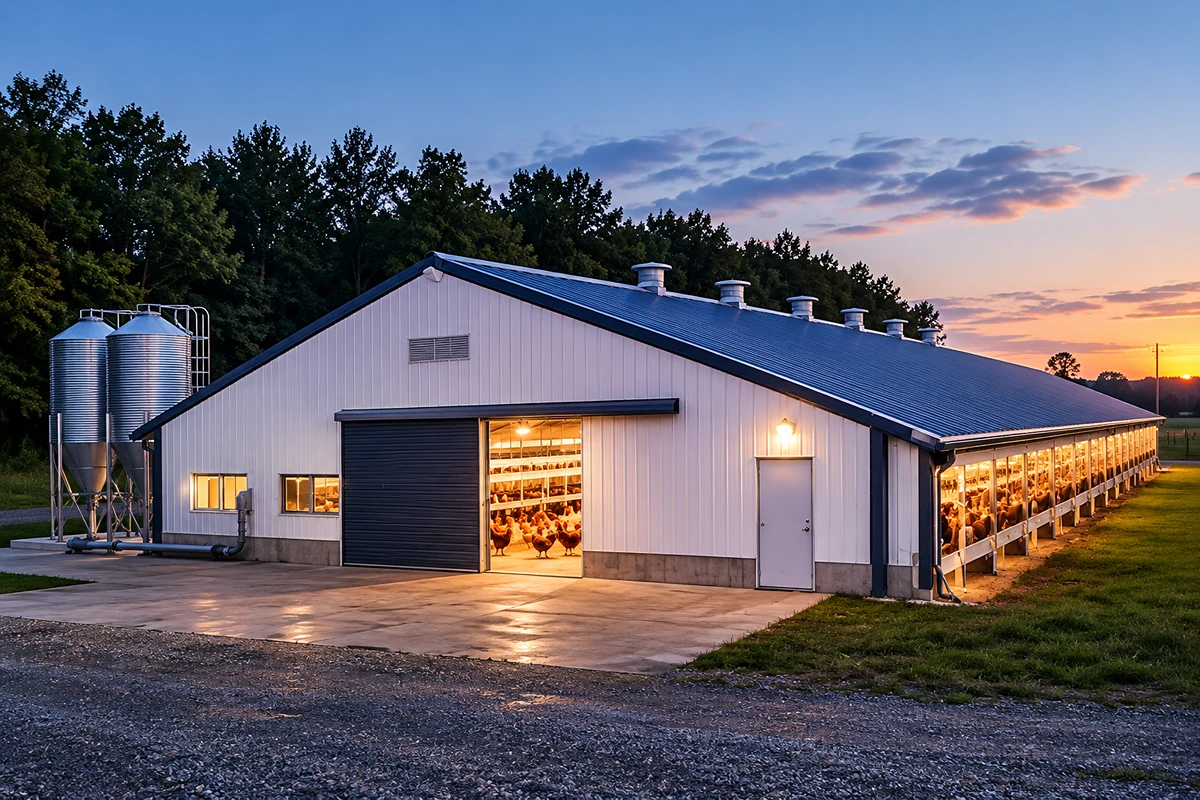
Dimensionnement du système de ventilation des bâtiments d'élevage en couches : la norme d'ingénierie qui distingue les bâtiments à haut rendement de ceux à faible rendement
La capacité de ventilation est mesurée en mètres cubes par heure (m³/h) par kilogramme de poids corporel de l'oiseau. Il s'agit de la norme internationale utilisée par toutes les grandes entreprises d'élevage et les fabricants de systèmes de contrôle environnemental. Un sous-dimensionnement peut entraîner une sous-estimation de la capacité de ventilation. système de ventilation pour maisons à étages L'erreur capitale #1 dans le secteur agricole.
Exigences standard en matière de ventilation pour les élevages de poules pondeuses utilisant un système de ventilation professionnel :
Poules pondeuses adultes (2,3 kg en moyenne) : 4,76 m³/h par kilogramme de poids corporel
Un élevage de 30 000 poules nécessite :
30 000 × 2,3 kg × 4,76 m³/h/kg = 328 440 m³/h
(Représenté ici comme un seul bloc de 30 000 oiseaux pour plus de clarté. En pratique, ce nombre serait réparti entre trois et six bâtiments — voir la section sur la biosécurité ci-dessous.)
C'est capacité maximale par temps chaud — la valeur qui détermine le choix du ventilateur pour tout système de ventilation efficace d'une maison à plusieurs niveaux. La ventilation minimale hivernale sert à éliminer l'humidité et les gaz plutôt que la chaleur, et fonctionne à un débit bien inférieur à cette valeur.
La règle est simple : dimensionner les ventilateurs au maximum pour l’été, puis les réduire au minimum pour l’hiver. Les exploitations agricoles qui adaptent leur taille à la demande hivernale — capacité réduite, coûts d'investissement moindres — seront confrontées à des pics d'ammoniac à chaque saison chaude. Voici pourquoi. Ingénierie professionnelle des systèmes de ventilation pour maisons à plusieurs niveaux importe.
La norme relative au renouvellement d'air saisonnier donne la même réponse dans un autre sens :
- Saison chaude (extérieur > 25°C) : renouvellement complet de l'air toutes les 1 minute
- Saison tempérée (15–25°C en extérieur) : toutes les 2 minutes
- Saison froide (< 15°C) : toutes les 3 minutes
Pour une maison de 100 m × 12,5 m × 4 m (5 000 m³), un renouvellement d'air complet par minute équivaut à 5 000 × 60 = 300 000 m³/h — ce qui concorde avec le chiffre par kilogramme indiqué ci-dessus. Les deux approches se confirment mutuellement.
Leçon clé : Les troupeaux plus importants et plus denses sont soumis à des besoins de ventilation proportionnellement plus élevés en été. Sous-dimensionner la capacité des ventilateurs pour réaliser des économies d'investissement entraîne une perte de production de 15 à 20 tonnes par saison chaude. conception du système de ventilation des maisons à plusieurs niveaux empêche cela.
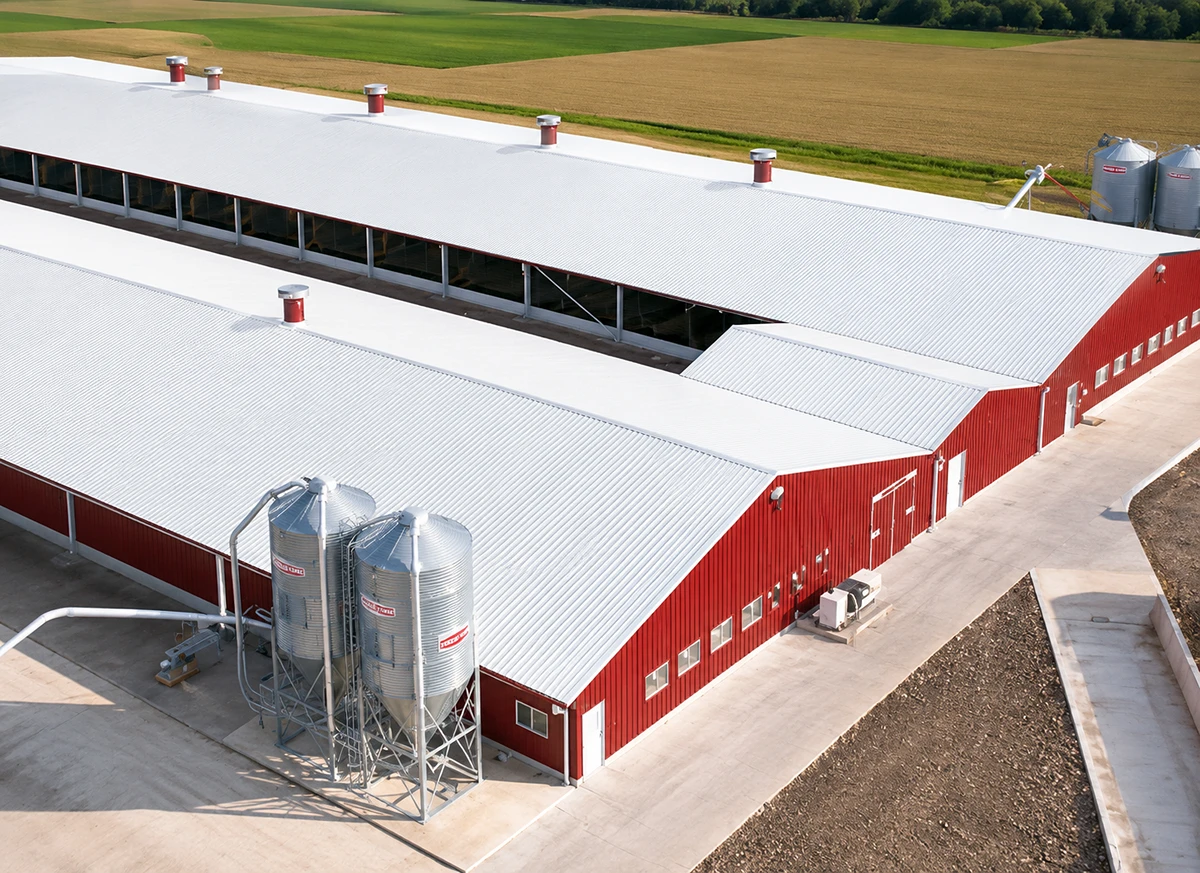
Production d'ammoniac et gestion de la litière : pourquoi la qualité du système de ventilation des poulaillers est importante
L'ammoniac n'apparaît pas par magie. Il provient du fumier, plus précisément de la décomposition de l'acide urique dans des conditions chaudes et humides.
Humidité de la litière plus élevée + température plus élevée = taux de production d'ammoniac plus élevé. Lorsque la capacité du système de ventilation du bâtiment d'élevage est limitée, cet ammoniac s'accumule.
Mais la ventilation seule ne suffit pas. L'enveloppe du bâtiment elle-même doit soutenir la stratégie du système de ventilation multicouche.
Pour qu'un système de ventilation multicouche fonctionne efficacement, le bâtiment doit être :
- thermoscellé – Prévenir les infiltrations incontrôlées qui contournent le système de ventilation du bâtiment et créent des zones mortes à forte concentration d'ammoniac
- Structurellement sain – Le contrôle par pression négative (−15 à −25 Pa) exige une construction étanche ; les bâtiments présentant des fuites ne peuvent maintenir les différentiels de pression nécessaires à la ventilation.
- Correctement isolé La stabilité thermique réduit les variations de température qui déclenchent la libération d'ammoniac par la litière. Variation optimale de la température ambiante : ±3 °C par jour.
De nombreuses exploitations utilisent des systèmes de cages modernes conçus pour 10 000 volailles, mais les logent dans des bâtiments en tôle ondulée présentant des fuites au niveau du toit et des murs. Les ventilateurs fonctionnent en permanence, les coûts énergétiques explosent, les variations de température sont importantes et le taux d'ammoniac continue de grimper en flèche en raison des fuites d'air non contrôlées. C'est pourquoi un professionnel… conception du système de ventilation des maisons à plusieurs niveaux nécessite une architecture professionnelle.
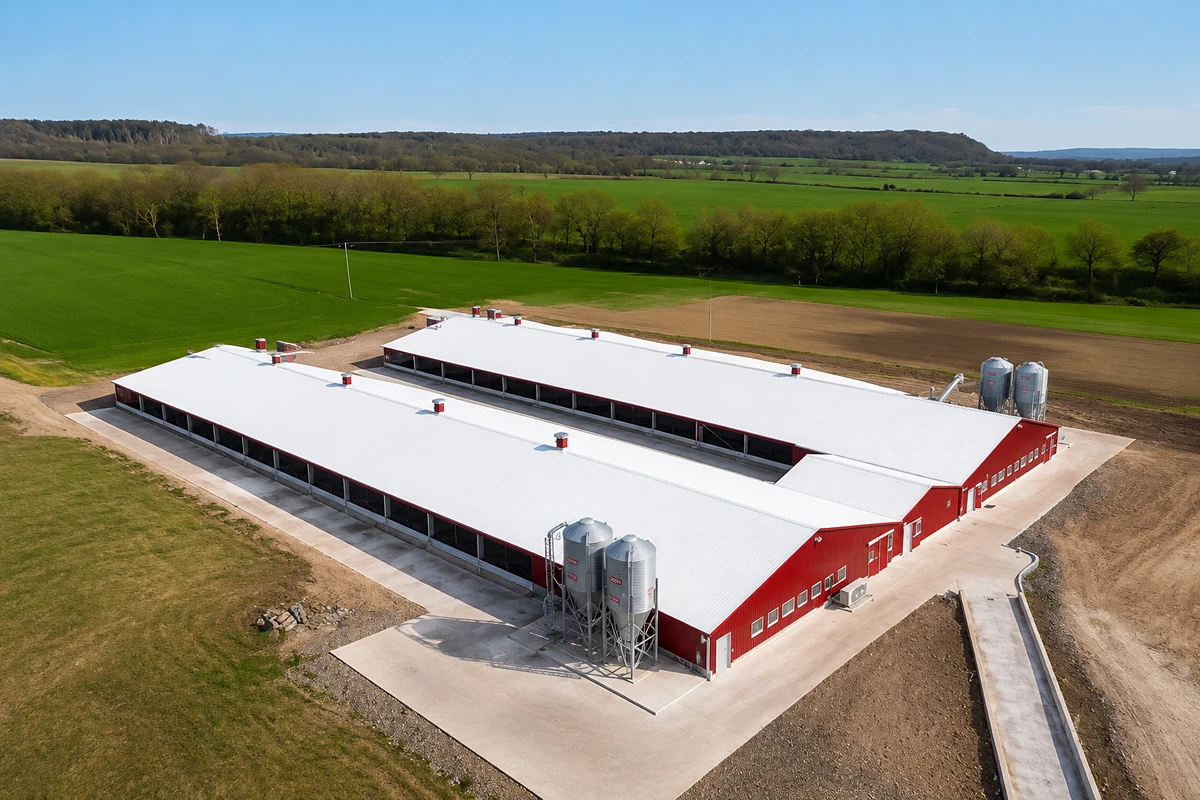
Séparation des maisons multiples : l’importance des systèmes de ventilation indépendants.
Les élevages de poules pondeuses modernes n'hébergent pas 30 000 oiseaux dans un seul bâtiment. Ils utilisent des bâtiments séparés dotés de systèmes de ventilation indépendants — généralement de 5 000 à 10 000 oiseaux par unité — car la biosécurité exige une séparation par âge et des cycles de dépeuplement rapides.
Une maison infectée doit pouvoir être nettoyée et désinfectée sans affecter la maison adjacente, qui est productive. Cela nécessite des systèmes de ventilation indépendants pour chaque unité :
- Systèmes de ventilation indépendants (sans conduits partagés)
- Espaces d'entrée/vestiaires séparés
- Pression négative maintenue uniquement à l'intérieur de la maison cible
- Aucune contamination croisée via le traitement de l'air partagé
Lorsque les systèmes de ventilation des poulaillers sont correctement conçus pour chaque maison indépendamment, la ferme gagne :
- Contrôle de l'ammoniac dans chaque unité sans interférence des unités adjacentes
- Capacité à mettre en quarantaine et à traiter une seule maison malade
- Flexibilité des horaires d'éclairage, d'alimentation ou de médication selon les différents groupes d'âge
- Respect facilité des réglementations environnementales (chaque maison est surveillée individuellement)
- Meilleure gestion thermique — les zones de nidification et les zones à lattes peuvent être maintenues à des températures optimales indépendantes
Le coût d'investissement est plus élevé (plusieurs systèmes de ventilation indépendants par bâtiment au lieu d'un système centralisé). En revanche, le coût d'exploitation est moindre car l'énergie n'est consommée que pour les bâtiments occupés, et les pertes de production dues à la transmission de maladies entre bâtiments sont éliminées.
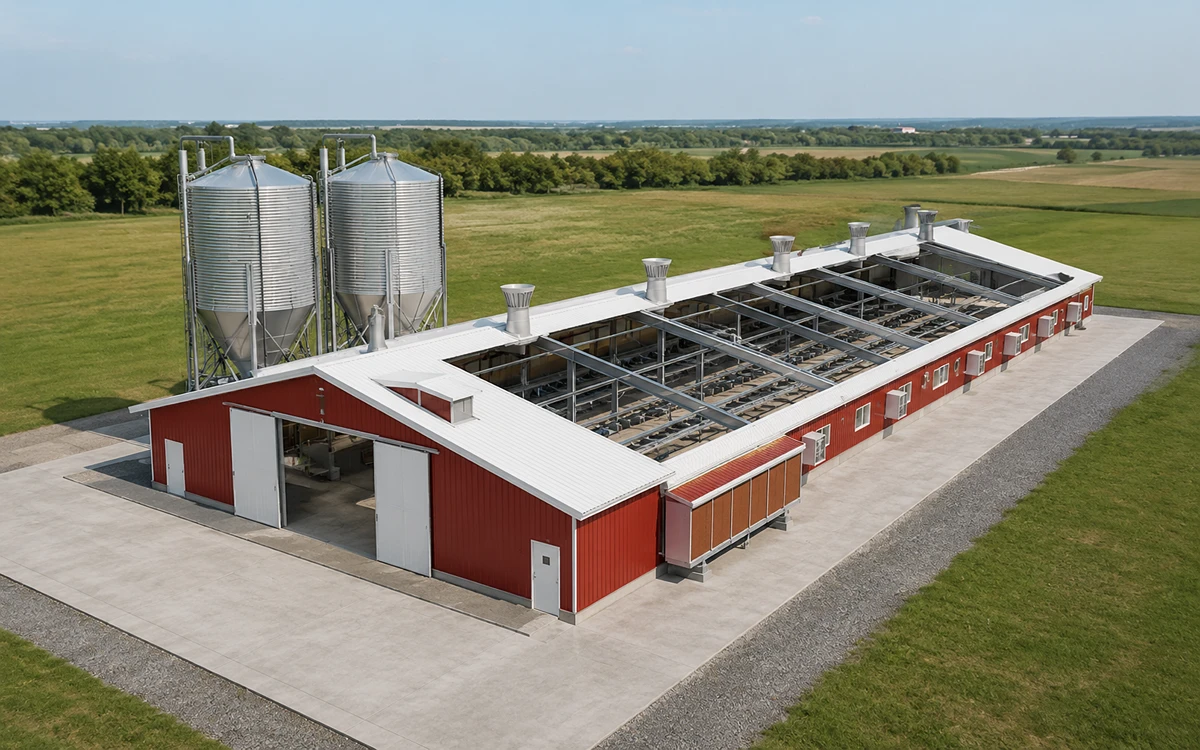
L'impact d'un système de ventilation professionnel pour votre maison : des chiffres concrets
Prenons deux scénarios, avec 30 000 poules pondeuses et des cycles de 72 semaines. Tous les montants sont en dollars américains. La principale différence réside dans la conception et la capacité du système de ventilation du bâtiment d’élevage.
Scénario A : Ventilation sous-dimensionnée, bâtiment présentant des fuites (système de ventilation de maison à double paroi défectueux)
| Ammoniac hivernal | 12–15 ppm (limite, supérieure à la norme de 10 ppm) |
| Ammoniac d'été | 45–60 ppm (toxique, susceptible de provoquer des maladies) |
| Taux de ponte moyen | 78 œufs/100 oiseaux/jour |
| Mortalité (72 semaines) | 8% (maladie respiratoire) |
| Conversion des aliments | 1,95 kg d'aliment par kg d'œufs |
| Revenu total du cycle | 390 000 USD |
| Coûts totaux | 272 000 USD |
| Bénéfice par cycle | 118 000 USD |
Scénario B : Conception professionnelle d’un système de ventilation pour maisons à étages
| Ammoniac hivernal | 5 à 8 ppm (sans danger, inférieur à la norme) |
| Ammoniac d'été | 8 à 12 ppm (sans danger, excellent confort pour le troupeau) |
| Taux de ponte moyen | 93 œufs/100 oiseaux/jour (97,9% de potentiel génétique) |
| Mortalité (72 semaines) | 3.5% (excellente gestion) |
| Conversion des aliments | 1,78 kg d'aliment par kg d'œufs |
| Revenu total du cycle | 468 000 USD |
| Coûts totaux | 254 000 USD |
| Bénéfice par cycle | 214 000 USD |
Différence de profit par cycle
214 000 USD – 118 000 USD = 96 000 USD de profit supplémentaire par cycle grâce à un système de ventilation professionnel pour maisons à étages.
Sur une durée de vie de l'actif de 10 ans — soit environ cinq cycles de 72 semaines — cela représente 480 000 USD de profit supplémentaire provenant d'une seule maison.
Différence de coût du capital : La conception professionnelle d'un système de ventilation multicouche pour une maison représente généralement entre 15 et 20 000 milliards de dollars du coût total de la maison. Pour une maison d'une valeur de 700 000 dollars, cela représente un investissement supplémentaire de 105 000 à 140 000 dollars. Retour sur investissement en un à un cycle et demi environ, soit moins de deux ans. Après cela, chaque cycle représente un profit supplémentaire pur.
Pourquoi VIKKINS se spécialise dans la conception de systèmes de ventilation pour les bâtiments d'élevage en couches
Nous concevons des systèmes de ventilation professionnels pour bâtiments à étages et des installations à structure métallique, car la maîtrise de l'environnement n'est pas une simple considération secondaire : elle fait partie intégrante de l'architecture. Un système de ventilation performant pour un bâtiment à étages ne peut fonctionner que si le bâtiment est conçu à cet effet.
Notre approche de la conception des systèmes de ventilation pour maisons à plusieurs niveaux :
- Performances thermiques de l'enveloppe Nous concevons les bâtiments pour obtenir des valeurs R minimisant les variations de température entre le jour et la nuit, réduisant ainsi la volatilité de l'ammoniac provenant de la litière. Le bâtiment est un élément essentiel au bon fonctionnement du système de ventilation par couches.
- Intégration de la ventilation L’emplacement des entrées et sorties d’air est modélisé afin d’éviter les courts-circuits et les zones mortes. La vitesse de l’air au niveau des volailles est calculée pour prévenir les courants d’air tout en assurant un renouvellement d’air complet au sein du système de ventilation du poulailler.
- Intégrité structurelle La structure en acier avec panneaux sandwich isolés maintient le différentiel de pression nécessaire au contrôle de la pression négative (de -15 à -25 Pa). L'absence de fuites d'air à travers les interstices ou les joints corrodés préserve le système de ventilation du bâtiment.
- Extension modulaire – La conception modulaire des systèmes de ventilation des bâtiments d'élevage permet à une exploitation agricole de passer de 3 à 10 bâtiments sans compromettre sa stratégie de contrôle environnemental.
- Documentation et conformité – La documentation technique structurelle, les plans du système de ventilation des différentes couches du bâtiment et les protocoles de surveillance environnementale sont fournis. Aucune conjecture n'est requise.
Capacité de production d'acier : VIKKINS produit annuellement 30 000 tonnes d'acier de construction sur ses sites de production de Cangzhou et Harbin, et dispose d'une capacité de production supplémentaire de 5 millions de m² de panneaux isolants. Cette capacité permet de réaliser des systèmes de ventilation pour des projets allant de 3 à plus de 50 maisons.
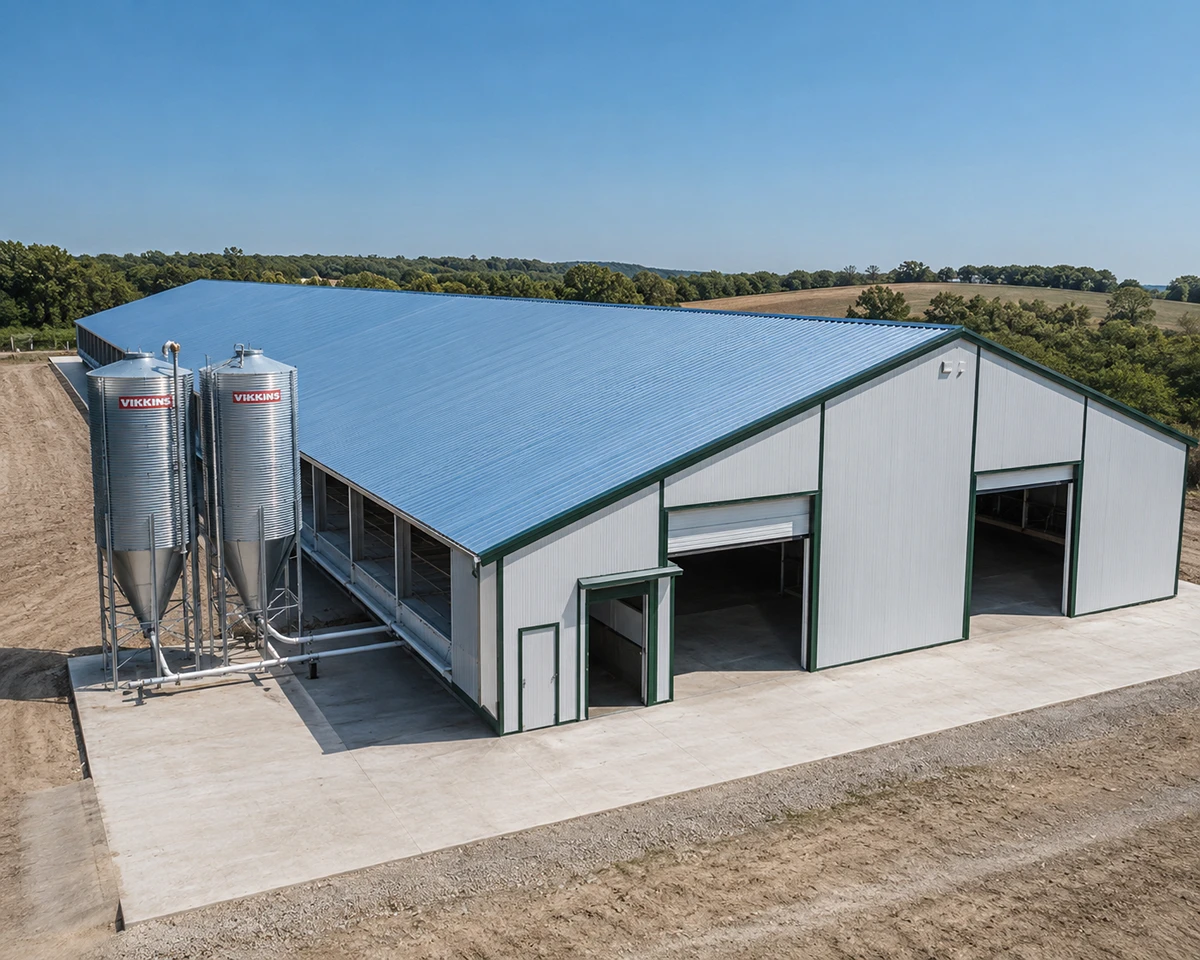
La question pour votre ferme
Si votre poulailler produit 78 œufs pour 100 poules alors que la génétique et l'alimentation devraient en produire 95, la première question à se poser n'est pas “ Quel est le problème avec l'alimentation ? ” ou “ Y a-t-il un virus caché ? ”
La première question est : “ Mon système de ventilation pour poulailler maintient-il le taux d'ammoniac en dessous de 10 ppm en toutes saisons ? ”
Si la réponse est inconnue — si vous n’avez pas de système de surveillance des gaz, ou si vous en avez un mais que vous ne le vérifiez pas régulièrement — vous perdez 15 à 201 TP3T de production à cause d’une dégradation invisible de la qualité de l’air due à un système de ventilation inadéquat du bâtiment.
Un système de ventilation professionnel pour poulailler permet d'éviter ces problèmes. Il garantit la stabilité des paramètres environnementaux de la 1re à la 72e semaine, empêche les pics d'ammoniac, limite les infections secondaires et préserve le potentiel génétique de votre élevage en préservant la qualité des œufs, au lieu de le perdre à cause du stress respiratoire.
La différence de coût est bien réelle. Le retour sur investissement est plus rapide que pour la plupart des investissements en capital dans la production avicole.
Votre système de ventilation pour poulaillers vous fait-il perdre de la productivité ?
Indiquez-nous la taille actuelle de votre troupeau, les dimensions du bâtiment et le taux de ponte moyen. Notre équipe d'ingénieurs environnementaux réalisera un audit de 24 heures sur les émissions d'ammoniac et de CO₂, modélisera le système de ventilation de votre bâtiment d'élevage selon les normes internationales et vous fournira un rapport contenant des recommandations spécifiques.
De nombreuses exploitations agricoles constatent des pics d'ammoniac de 8 à 12 ppm qu'elles n'avaient jamais surveillés. Nous vous aidons à quantifier le coût d'une mauvaise ventilation de votre poulailler et à concevoir une solution professionnelle adaptée.
📧 sales@vikkins.com
📱 +86-139-1005-4364
Apprenez-en davantage sur les systèmes de ventilation professionnels pour maisons à étages.