









In a pre-engineered metal building (PEB), the girt offset looks like a minor line on an order form — yet it drives steel weight, cost, thermal performance and interior clearance. When you fill out an order form or model a building, you eventually have to choose how the girts sit relative to the columns: bypass, inset, or flush. This is not just a detail of how they attach — it changes the girt’s structural model, deciding whether the wall girts work as a continuous beam or a simple span. That, in turn, shows up in steel tonnage, cost, insulation performance and clearance.
What a girt and its offset actually are
A girt is a horizontal secondary framing member that runs along the wall between the main-frame columns and endwall columns. Its job is to support the wall panels and transfer wind load back to the primary frame. Girts are usually cold-formed Z (Zee) sections, in common depths of 8″ / 10″ / 12″ (≈200 / 250 / 300 mm) and gauges of 16 / 14 / 13 / 12.
Girt offset is the distance from the sidewall or endwall “steel line” (the wall datum plane) to the outside face of the supporting column flange. This single dimension fixes the relative position of column, girt, panel and insulation — and therefore whether the girt is engineered as a continuous beam or a simple span. The three standard conditions: bypass 8″/10″/12″ (some makers list 9-1/2″), inset 1″, and flush 0″.
The three conditions in one view
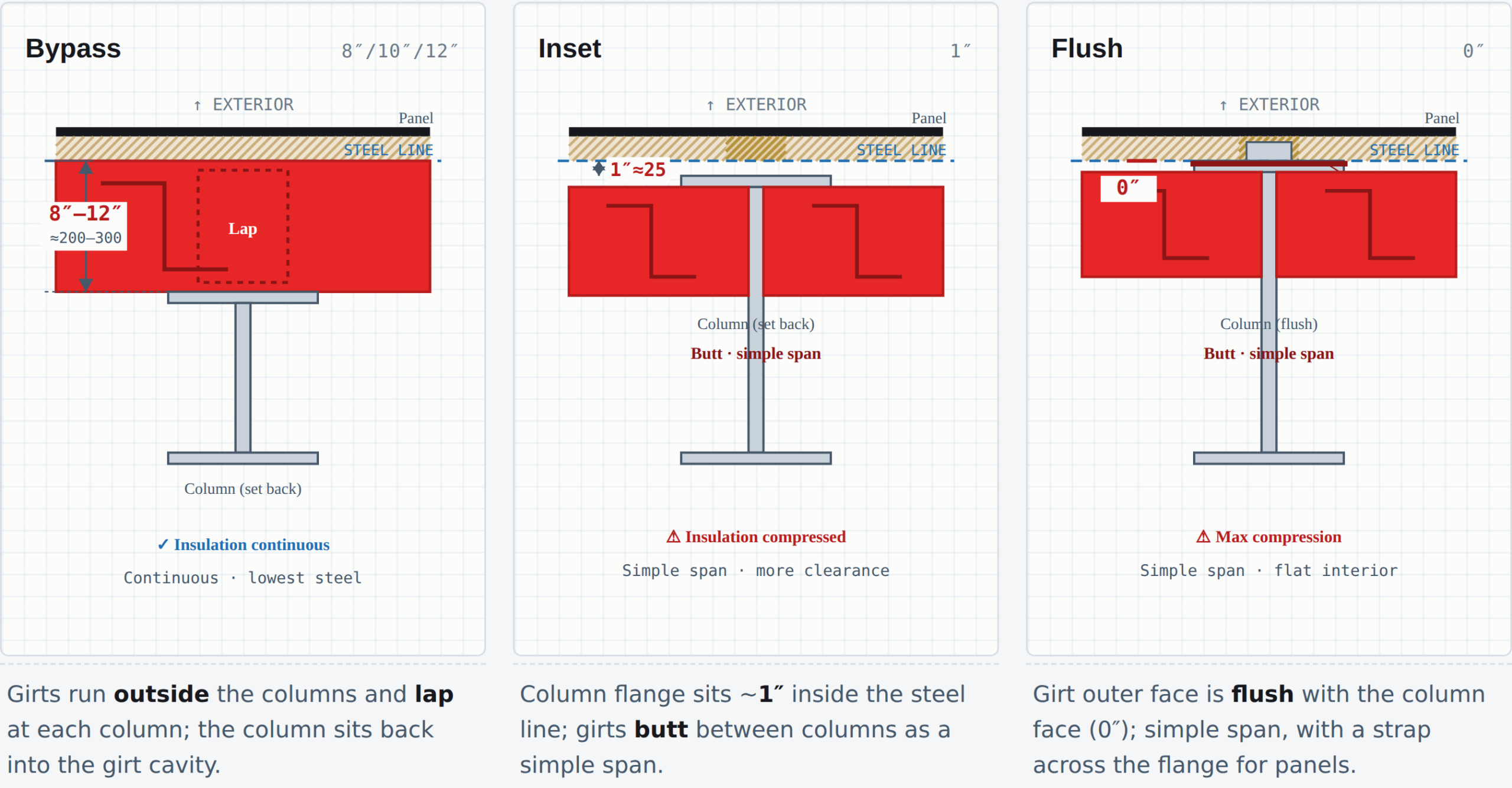
How each condition behaves
Bypass — offset 8″ / 10″ / 12″ · continuous beam
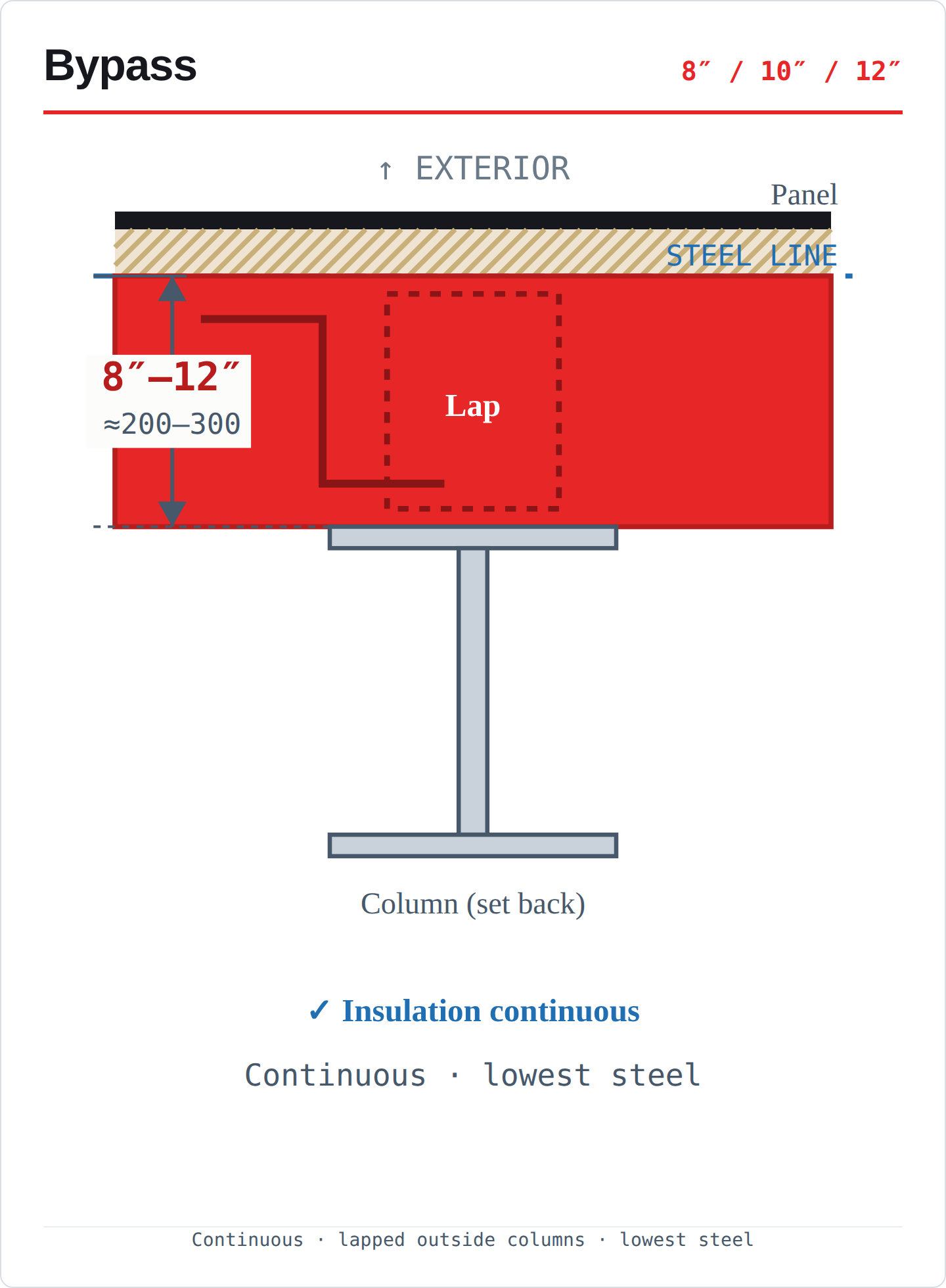
Girts run entirely on the outside of the columns and lap at each column, forming a member that is continuous along the building length. Engineered as a continuous beam, the mid-span moment drops, thinner sections can be used, and the system is stiffer, lighter and cheaper — the most economical and most common choice.
- Strengths: lowest steel weight and cost; stiffer system; column set back so blanket insulation is not compressed at columns (fewer thermal bridges); can be lapped (cheapest) or butted (eases future openings).
- Trade-offs: column occupies the girt cavity (standard clearance); an air space equal to the girt depth sits between column and panel.
Inset — offset 1″ · simple span
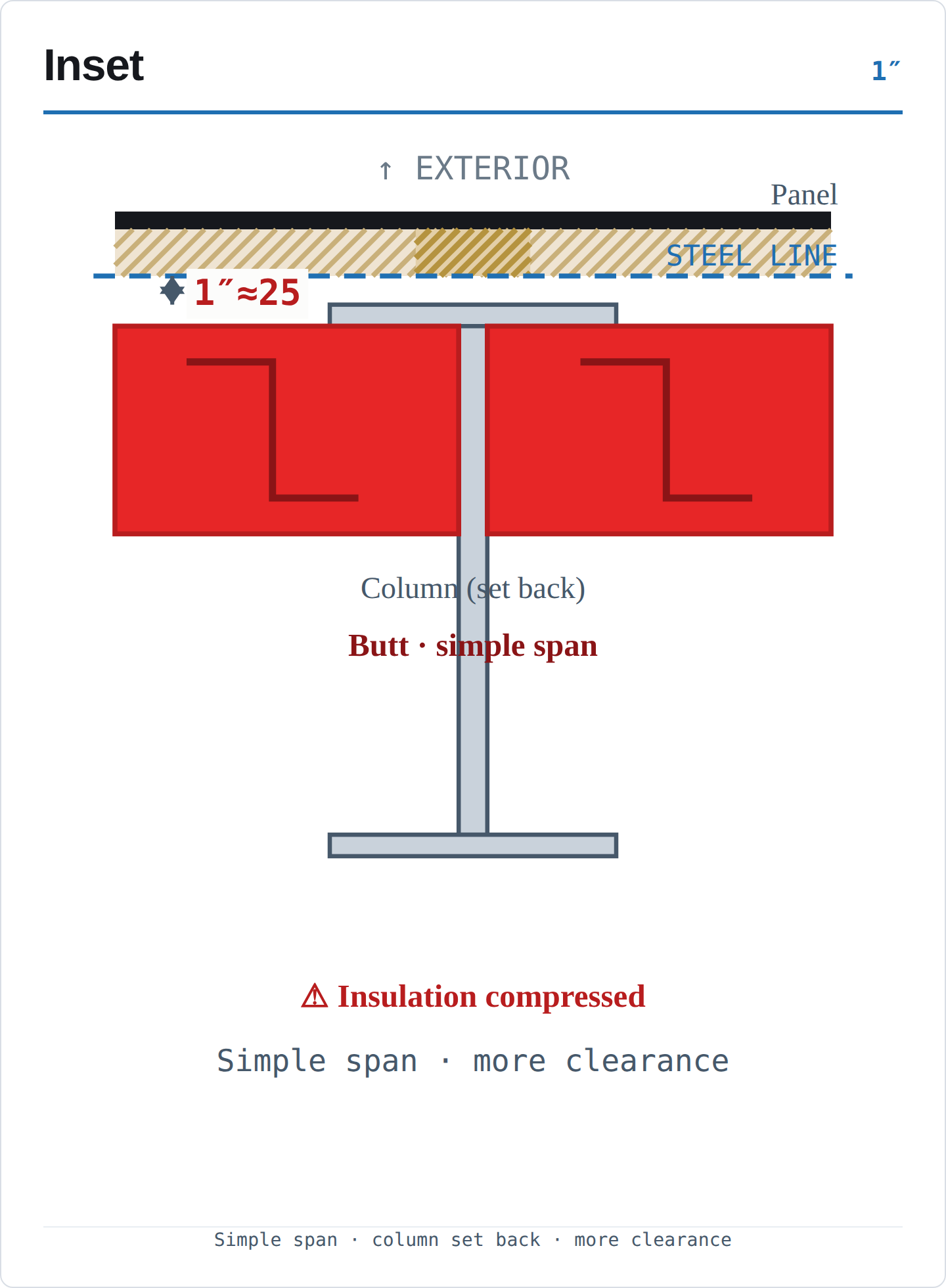
The column outer flange sits about 1″ (≈25 mm) inside the steel line; girts are inset and butt between columns. They cannot span continuously past the columns, so they are designed as a simple span.
- Strengths: columns set back give noticeably more clearance between columns; smaller air space.
- Trade-offs: simple-span action requires heavier girts, raising girt-system cost by 30%–100%; insulation is compressed at the columns (thermal bridge).
Flush — offset 0″ · simple span
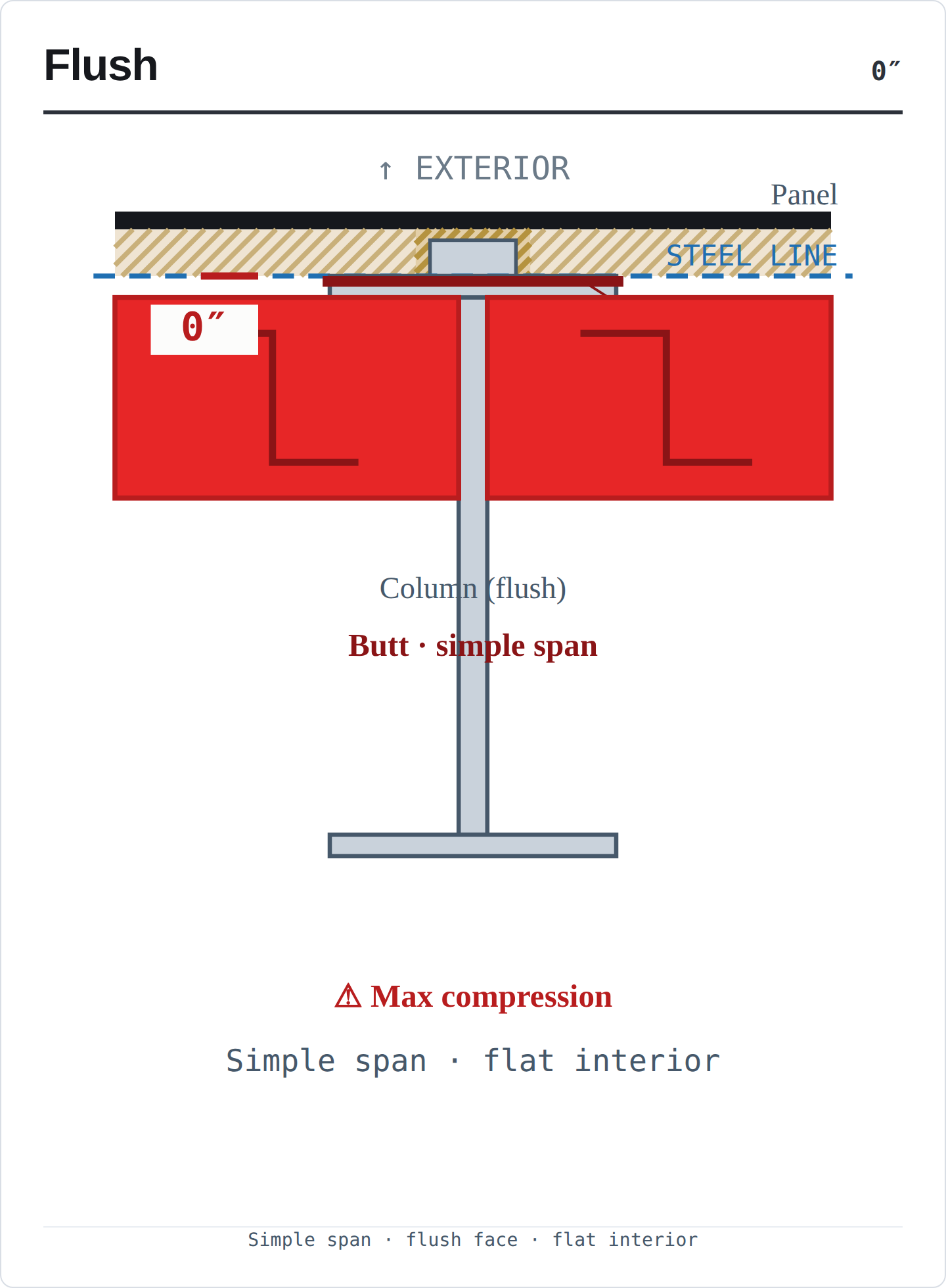
The girt outer face is flush (0″) with the column outer face. Girts connect to the column web/flange and butt between columns as a simple span; a strap is typically added across the column flange for panel attachment.
- Strengths: flattest interior wall and the most usable floor area; no exterior air space; suits drywall and masonry finishes.
- Trade-offs: simple span means higher steel weight and extra attachment material; insulation compression at columns is the greatest of the three.
Side-by-side comparison
| Condition | Offset | Structural model | Steel weight / cost | Insulation at column | Column clearance | Typical use |
|---|---|---|---|---|---|---|
| Bypass | 8″/10″/12″ | Continuous (lapped) | Lowest | Not compressed | Standard | Default choice; high wind / large bays |
| Inset | 1″ | Simple span (butted) | +30–100% | Compressed | Greater | When more column clearance is needed |
| Flush | 0″ | Simple span (butted) | High | Most compressed | Large / flat wall | Flat interior; maximum floor area |
How big is the cost gap?
For a 100′ × 200′ × 16′ building (≈30.5 × 61 × 4.9 m) with 25′ (≈7.6 m) column spacing, switching from bypass to inset/flush adds more than 4,000 lb of girts (≈1.8 t) — about a +95% girt-system weight increase and roughly +8% on whole-building steel. On a cost basis, a separate data set shows the girt system rising about 70% and the overall project about 3% (~+$3,000). The gap widens with higher wind loads and larger bay spacing.
Source: published engineering tips from North American PEB makers (American Buildings / Kirby Building Systems). Figures are order-of-magnitude; final project design governs.
Girt selection logic
- Default to Bypass. With no special requirement, bypass wins on steel weight, stiffness, insulation and cost — and the advantage grows with larger bays and higher wind loads.
- Need more clearance between columns? Consider Inset — the 1″ offset pulls the columns back, at a higher cost.
- Need a flat interior or maximum floor area? Consider Flush, accepting higher cost and an insulation penalty.
- Energy-sensitive project? Watch the thermal bridge: inset and flush compress insulation at each column.
- Future openings planned? Use a butted (simple) bypass for easier field locating.
Câu hỏi thường gặp
What exactly does girt offset measure?
The distance from the wall steel line (the wall datum plane) to the outside face of the supporting column flange.
Why is a bypass girt more steel-efficient?
The girts lap at each column to form a continuous beam, lowering the mid-span moment so thinner sections can carry the load. Inset and flush girts are simple spans and must be heavier.
What is the difference between inset and flush?
Inset has a ~1″ offset with the column slightly set back, giving more clearance. Flush has a 0″ offset with the girt face level with the column face for the flattest interior and maximum floor area. Both are simple spans and cost more than bypass.
Which condition is best for insulation?
Bypass — the column sits back inside the girt cavity, so blanket insulation is not compressed at the columns.
Which one do you usually recommend?
Bypass for most projects. Choose inset or flush only when you specifically need greater column clearance or a flat interior / maximum floor area.
Talk to VIKKINS
VIKKINS delivers turnkey pre-engineered steel buildings across the Americas — Canadian engineering standards, efficient manufacturing, and a track record of 362+ projects in 90+ countries (EN · ES · FR · 中文). Send us your project parameters and our engineering team will balance cost, clearance and thermal performance. Talk to VIKKINS Engineering or email sales@vikkins.com.