






Industry insight · Materials
Sandwich Panel Core Materials: How to Choose Between EPS, PU/PIR, Rock Wool and Glass Wool
The steel facing gets all the attention, but the core inside the panel quietly decides three things you live with for 25 years: whether the building meets fire code, what you pay to heat or cool it, and what the panels cost up front. Here is how the four common cores really compare — so you don’t over-spec or under-build.
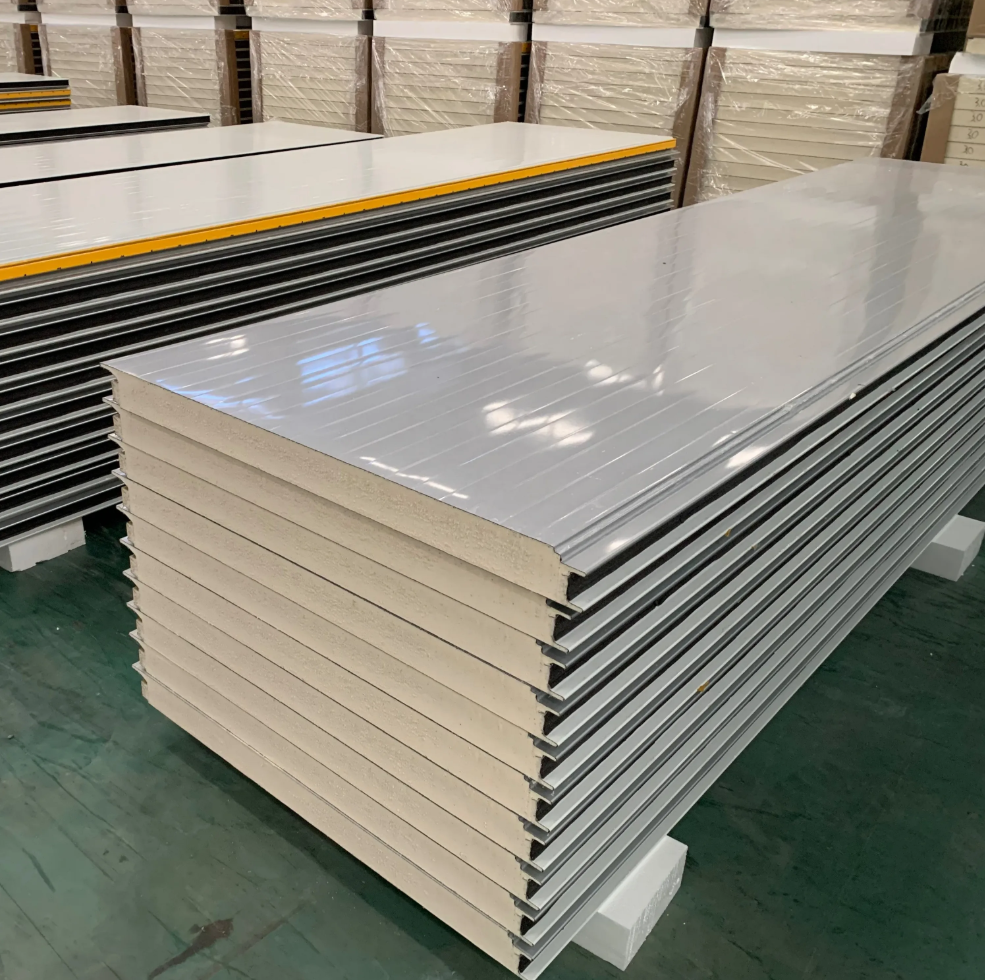
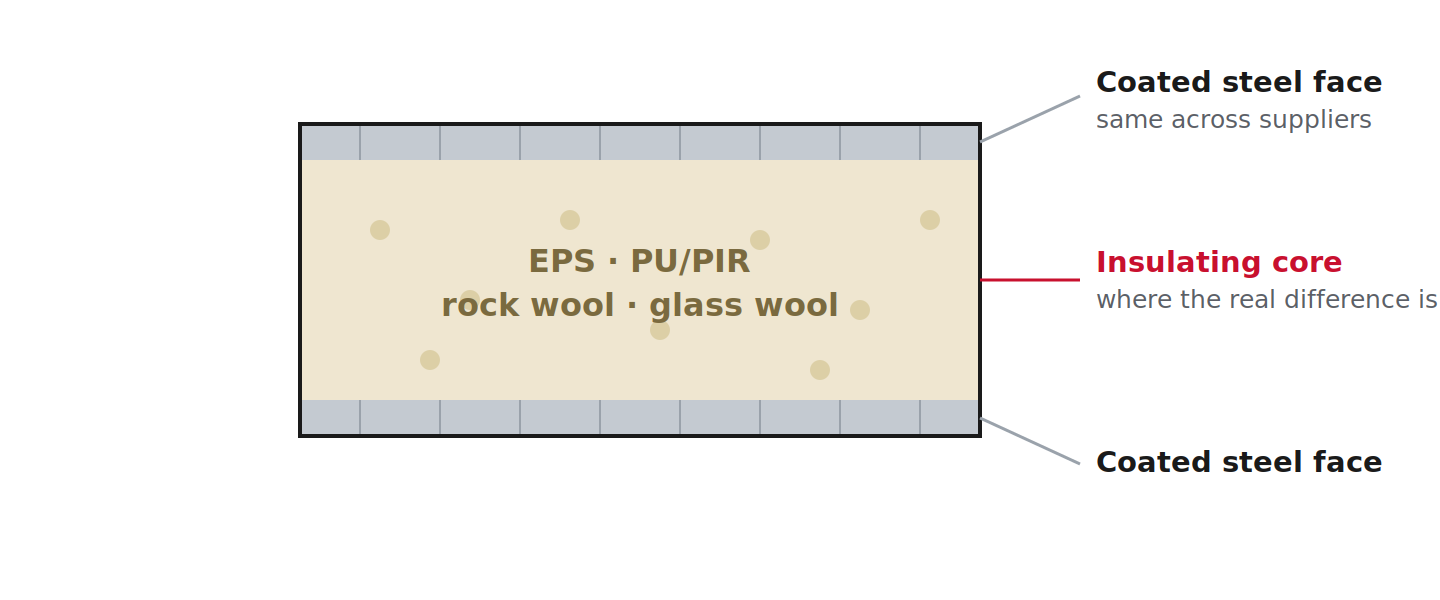
Four cores dominate the market: EPS, PU/PIR, rock (mineral) wool and glass wool. Choosing between these sandwich panel core materials isn’t about which is “best” in the abstract — each wins on a different axis. The trick is knowing which axis your project is actually graded on. Work through them in this order.
Start here — fire.
The one property that can disqualify a panel outright
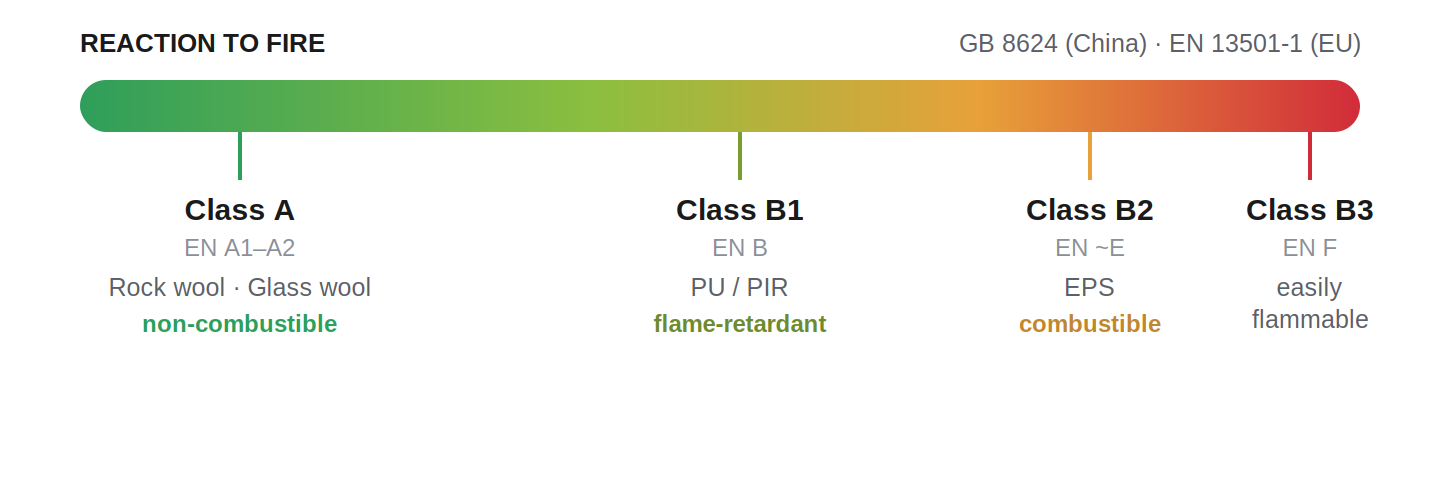
Fire performance is the only spec that can fail your building before it’s even occupied — and it’s graded differently depending on where you build. China’s GB 8624 sorts materials into four classes: A (non-combustible), B1 (flame-retardant), B2 (combustible) and B3 (easily flammable). Europe’s EN 13501-1 uses a finer seven-class scale (A1 to F), and North America uses ASTM E84. GB 8624 was aligned with the European system but isn’t a strict one-to-one match, so always check which standard a datasheet quotes. The split that matters underneath all of them: mineral cores don’t burn, organic cores do.
Rock wool and glass wool are non-combustible — Class A under GB 8624, A1 or A2 under EN — with rock wool withstanding well over 1000°C. PU and PIR are flame-retardant, Class B1 (EN class B); PIR is the stronger of the two, charring and self-extinguishing rather than feeding the fire. EPS is combustible — Class B2, though a flame-retardant grade can reach B1 — and standard EPS melts and drips as it burns. Since Grenfell, many markets now require non-combustible (Class A) cores for facades and tall buildings outright, so check the local code before anything else.
Then — thermal performance.
Your heating, cooling and panel-thickness bill
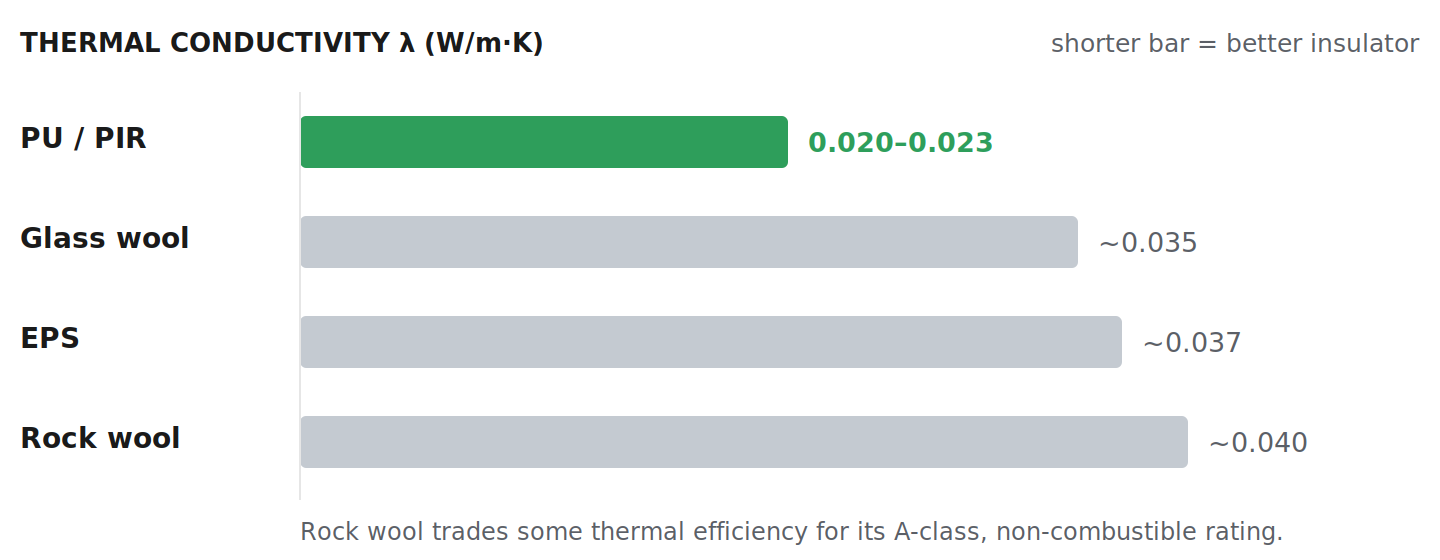
Insulation is rated by thermal conductivity, λ (lambda), in W/(m·K). Lower is better — a lower λ means you hit the same U-value with a thinner panel, which saves both energy and wall space. This is where the organic cores pull ahead.
PU and PIR lead clearly at roughly 0.020–0.023, so for a given performance they give you the thinnest, lightest panel. EPS and the mineral wools sit higher, around 0.034–0.041. That gap is decisive for refrigerated buildings, where every extra millimetre of wall is lost internal volume — which is why cold stores and freezers are built almost exclusively with PU/PIR.
Then — weight, sound, moisture, cost.
The trade-offs that decide close calls
Weight follows density: EPS is the lightest core at roughly 15–20 kg/m³, while rock wool runs 100–120 kg/m³ — heavy enough to add up across a large roof and affect your structural load. On acoustics, rock wool is the clear winner, which is why it shows up in workshops, gyms and anywhere noise matters. For moisture, the closed cells of PU/PIR resist water well, while mineral wools must be kept properly sealed.
On price, EPS is cheapest by a wide margin; PU/PIR and rock wool sit at the top, with glass wool in between. But the cheapest panel isn’t always the cheapest building — a low-cost EPS wall can lose its edge over 20 years through higher energy use and, in the wrong application, fire or insurance penalties.
The four sandwich panel core materials at a glance
| Core | Fire class (GB / EN) | λ (W/m·K) | Weight | Cost | Best for |
|---|---|---|---|---|---|
| EPS | B2 / EN ~E — combustible | 0.034–0.038 | Lightest | Lowest | Budget warehouses, low fire-risk walls & roofs |
| PU / PIR | B1 / EN B — flame-retardant | 0.020–0.023 | Light | High | Cold storage, freezers, food & pharma |
| Rock wool | A / EN A1–A2 — non-combustible | 0.038–0.041 | Heaviest | High | Fire walls, fire compartments, industrial, acoustics |
| Glass wool | A / EN A1–A2 — non-combustible | 0.032–0.040 | Medium | Medium | Lighter fire-rated builds, acoustics on a budget |
Figures are typical industry reference ranges; exact values depend on density and manufacturer. Always confirm against the certified datasheet for the specific panel.
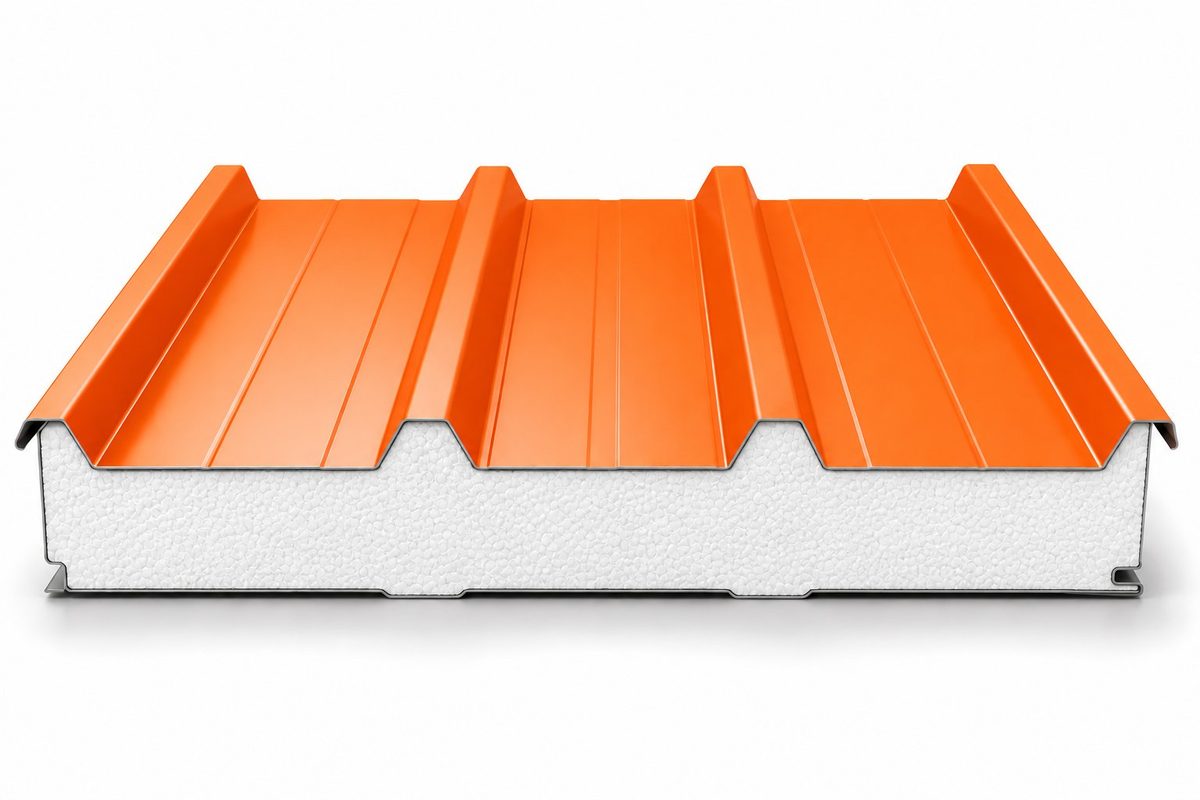 EPS panel — lightest, lowest-cost core for lower fire-risk builds. |
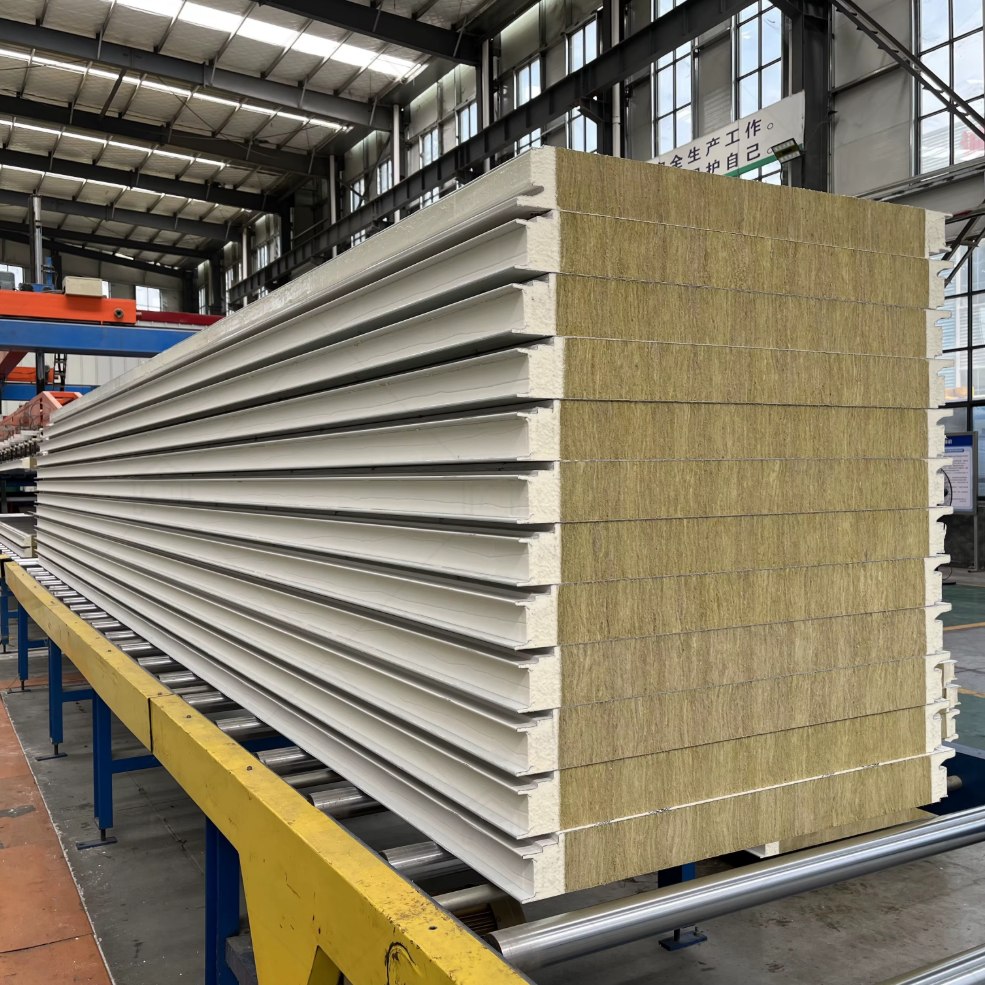 Rock wool panel — non-combustible A-class core for fire-rated walls. |
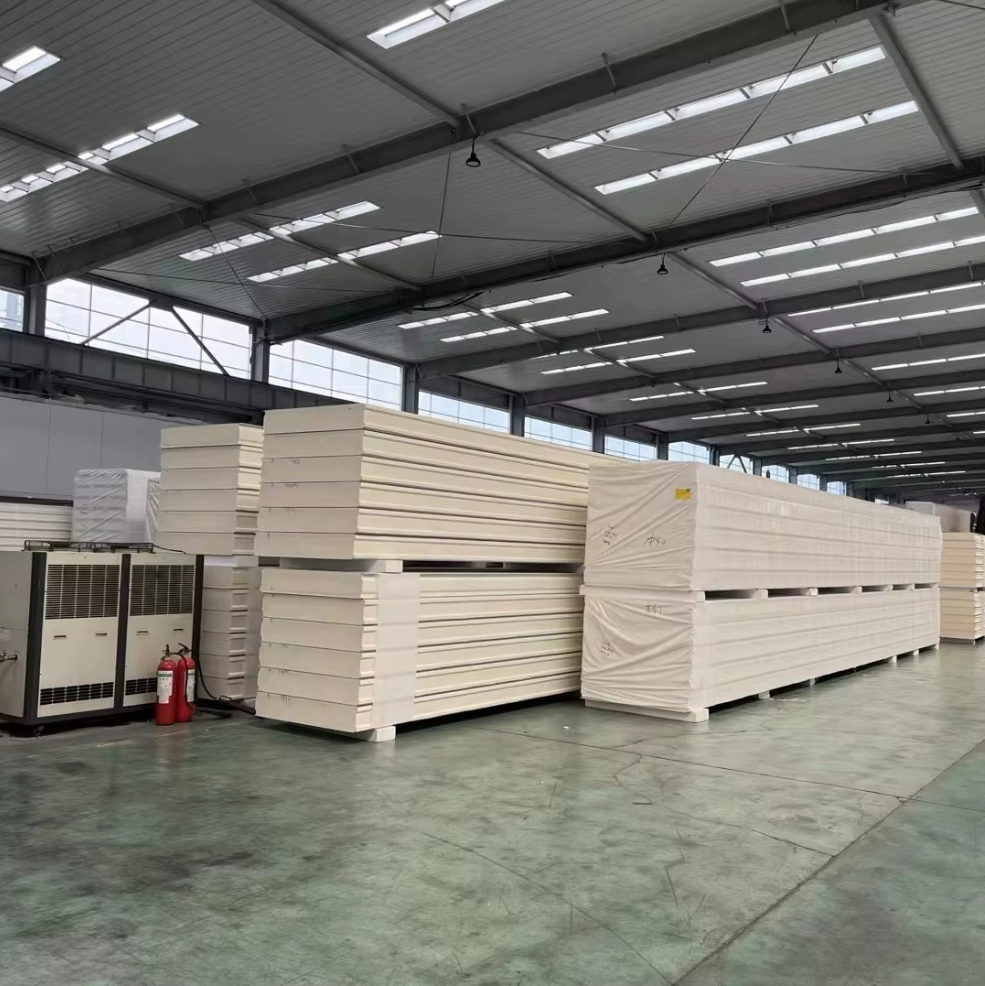 PIR cold-room panel — closed-cell core for refrigerated builds. |
The shortcut.
Three questions that pick the core for you
1. Does the code or insurer demand a non-combustible (A-class) core? If yes — common for facades, tall buildings, escape routes and many public projects — you’re choosing rock wool or glass wool, full stop.
2. Is the space refrigerated? Cold rooms, freezers and temperature-controlled logistics want the thinnest, most efficient wall, so PU/PIR is the default.
3. Is it a standard, lower-risk building on a tight budget? A dry warehouse or workshop with no special fire demand is the classic case for EPS — just price in the lifetime energy cost before you commit.
Spec the core to the job, not to a sales sheet
The reason there’s no single “best” sandwich panel core material is that fire, thermal, weight and cost rarely point the same way — the right answer is the one that matches what your project is actually graded on. VIKKINS manufactures all four cores, so our advice isn’t steered by what we happen to stock: rock wool when you need A-class fire safety, PU/PIR when you need cold-store efficiency, EPS when budget leads and the risk profile allows it. Engineered in Canada, built in China, delivered to 90+ countries — send us the application and the local code, and we’ll tell you which core actually fits.
Let’s build something together
Tell us your project dimensions and use — we’ll send a preliminary design and quote within 24 hours. Service in English, Spanish, or French.