




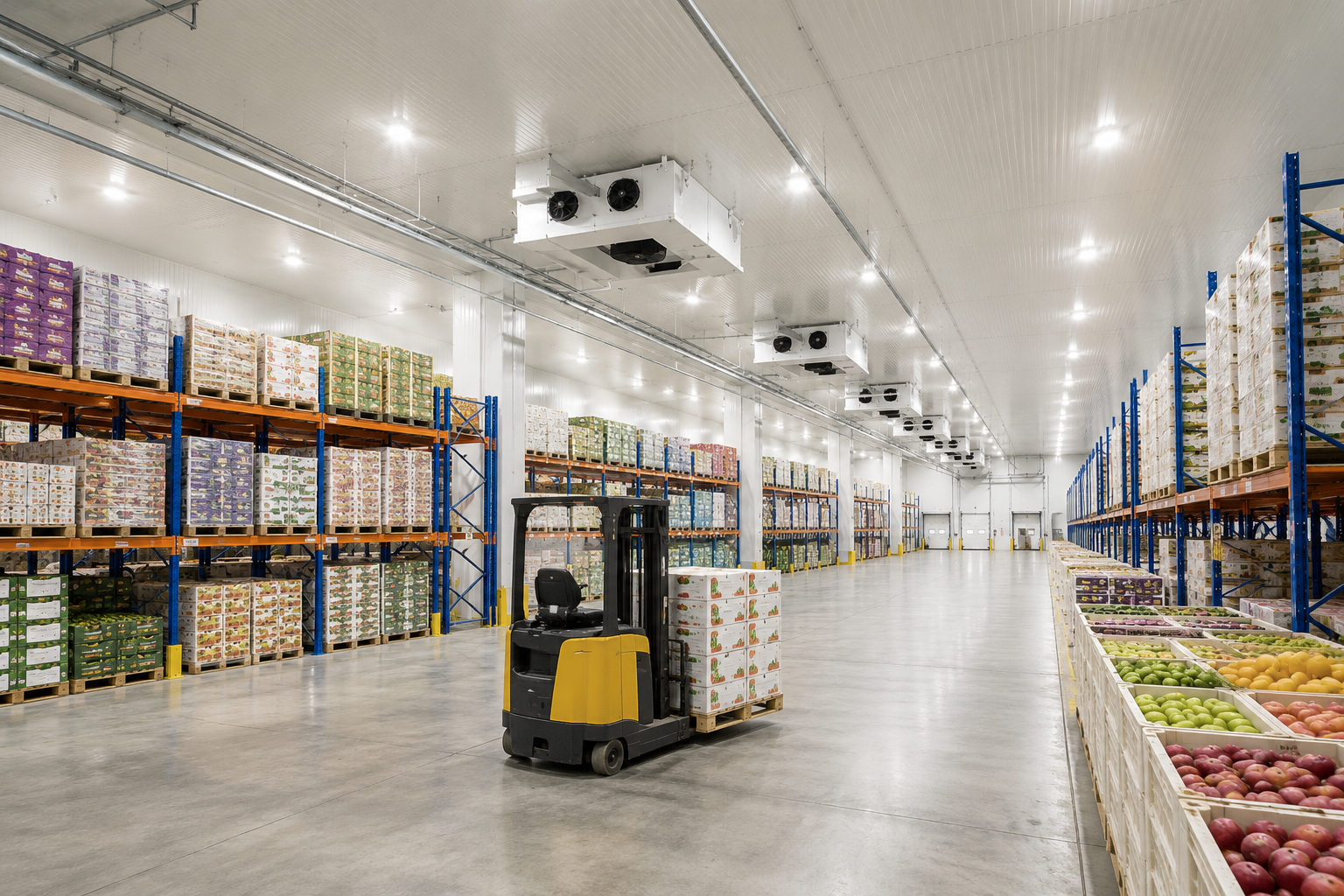
A cold room that performs beautifully in a temperate country can struggle the moment it is built somewhere hot. Cold storage in hot climates has to fight a much bigger temperature gap, higher humidity, stronger solar gain and, in many markets, an unreliable grid and salt-laden coastal air. Spec it the way you would for a mild climate and you get a room that never quite holds temperature, ices up at the door and burns power all year. This guide covers the five things that change when you design a cold room for Africa, the Gulf, the Caribbean or any hot, humid market.
Why hot climates change the cold room equation
Refrigeration works by moving heat from inside the room to the air outside. When that outside air is 40–45 °C instead of 25 °C, the plant has to work far harder to reject the same heat, and more heat is pushing in through every wall, door and roof. Add tropical humidity and the moisture load rises too. None of this is exotic — it just means the room has to be specified for the conditions it will actually live in, not the conditions in the catalogue.
1. Thicker insulation, higher-spec panels
The envelope is your first defence against ambient heat, so hot-climate rooms lean to the thicker end of the range. Where a temperate chiller might use 100 mm, a hot-climate room often steps up, and freezers move to 150 mm as standard. What matters as much as thickness is the core: a high-density polyurethane or PIR insulated sandwich panel (around 40–45 kg/m³) resists heat far better and does not sag or absorb moisture over time. It is the same logic as choosing your cold room panel thickness — only the ambient design temperature is higher.
2. Refrigeration sized with real headroom
The most common hot-climate mistake is sizing the plant for a mild design day. If the condenser is rated for 25 °C ambient and the site hits 45 °C, capacity drops exactly when you need it most — through the afternoon, every day. Hot-climate rooms need a higher condensing design temperature, a bigger cooling-load margin, and enough evaporator and airflow to pull temperature down after every door opening. Getting this right starts at the design stage, alongside your overall cold room sizing and cooling-load calculation.
3. Humidity and condensation control
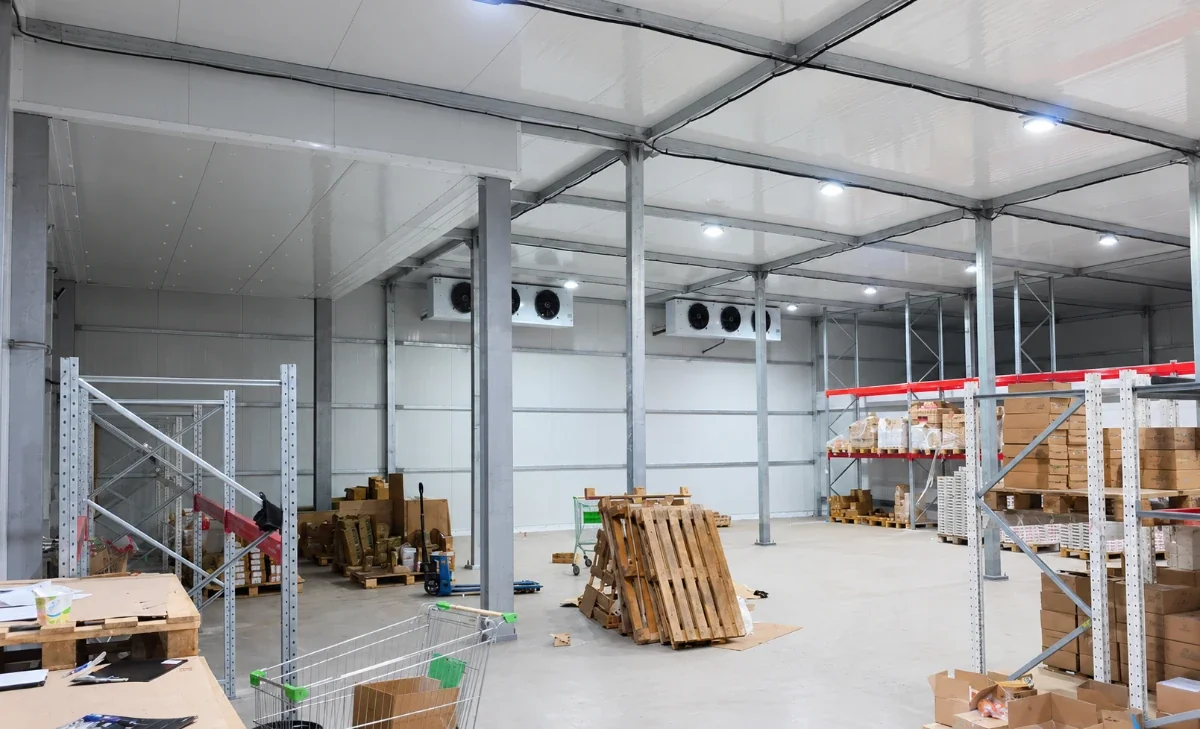
High outside humidity means warm, moist air rushes in every time a door opens and condenses on cold surfaces — showing up as dripping ceilings, wet floors and ice at the door frame. The defences are a tight door seal, frame heating on freezer doors, a continuous vapour barrier in the panel joints, and a well-detailed floor that does not sweat or heave. A fast-closing or high-speed door pays for itself quickly here, because every extra second the door stands open lets more humid air in.
4. Corrosion protection for coastal and marine air
Many hot markets are also coastal — island nations in the Caribbean, Gulf ports, West African harbours. Salt-laden air attacks thin coatings and cheap hardware fast. For these sites, specify stainless or heavily galvanised steel skins, stainless door hardware, and corrosion-rated fasteners. It is a small premium at build time that avoids rust streaks and seized hinges a year or two in.
5. Power reliability
In markets with an unstable grid, refrigeration that stops every time the power dips is a real risk to stored goods. Design for it: allow for generator back-up, consider solar support where daytime load and sun align, and lean on a well-insulated envelope that holds temperature longer during an outage. A tighter thermal envelope is not just an energy saving — it is your buffer when the power goes.
Built for the climate you are in
Vikkins exports cold-chain systems to more than 90 countries across Africa, the Americas and the Gulf, packed for sea freight and engineered for the ambient conditions of each destination rather than a generic spec. The panels, doors, refrigeration headroom and corrosion protection are matched to your climate — the same discipline behind our cold storage solutions. It is the difference between a room that copes with a heatwave and one that fails during it.
Frequently asked questions
Do cold rooms need thicker panels in hot climates?
Generally yes. A bigger gap between outside and inside temperature means more heat to keep out, so hot-climate rooms lean to thicker, higher-density panels — freezers commonly at 150 mm — to hold temperature without overworking the plant.
Why does my cold room struggle in the afternoon heat?
Usually the refrigeration was sized for a mild design temperature. As ambient climbs toward 40–45 °C the condenser loses capacity, so the room drifts warm at the hottest part of the day. The fix is designing for the real peak ambient with proper headroom.
How do you stop condensation in a humid-climate cold room?
Control the moist air getting in: a tight, well-maintained door seal, frame heaters on freezer doors, a continuous vapour barrier in the panel joints, a floor detailed against sweating, and fast door closing to cut the time the room stands open.
Can Vikkins ship a cold room to Africa, the Gulf or the Caribbean?
Yes. Vikkins delivers cold-chain systems to over 90 countries, packed for sea freight with design, supply and installation support, engineered for the destination’s climate.
Tell us your project dimensions and use — we’ll send a preliminary design and quote within 24 hours. Service in English, Spanish, or French.