








H-beam vs I-beam is one of the most basic decisions in steel construction — and one buyers almost never see. Yet the sections your supplier puts into a building quietly decide whether it is safe, efficient, or quietly over- or under-built. Here is the real difference between the two, the four types of H-section, and why modern steel buildings are built almost entirely from H-sections.
H-beam vs I-beam: the core difference
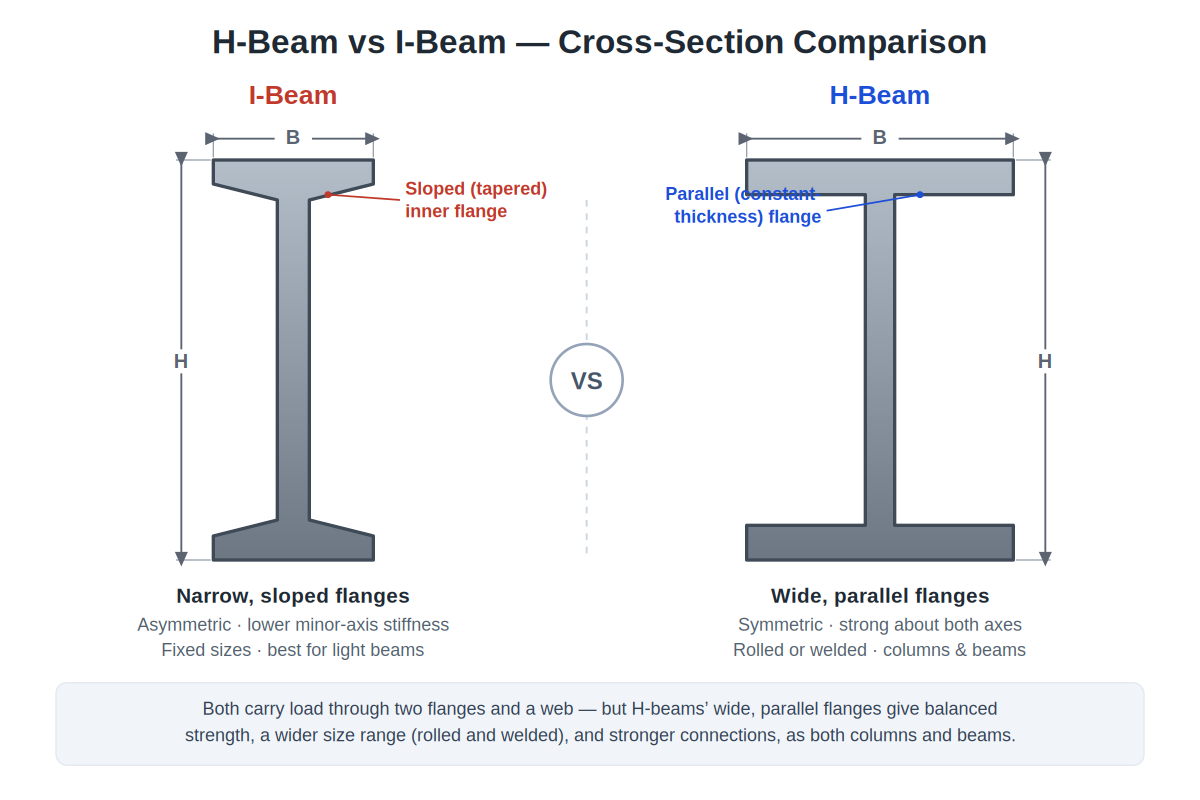
An I-beam has narrow flanges with sloped, tapered inner faces. The section is asymmetric — strong about its major axis but comparatively weak about its minor axis — and it is rolled only in a limited range of fixed sizes. It does one job well: simple, lightly loaded beams.
An H-beam — known internationally as a wide-flange, W-shape, or universal beam and column — has wide flanges with parallel, constant-thickness faces. The section is close to symmetric, with balanced strength in both directions, and it is available in a far wider range of sizes. When a project needs something off the standard list, H-sections can also be fabricated as welded built-up members for non-standard spans.
The four types of H-section steel
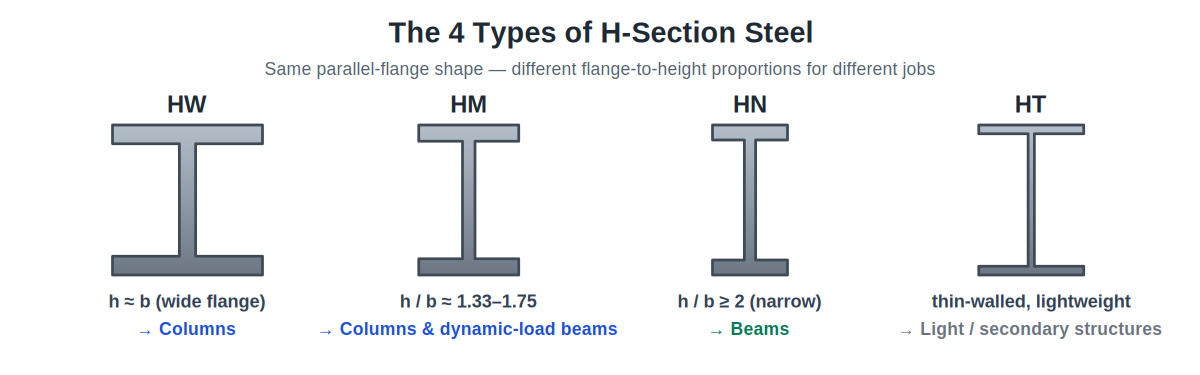
Not all H-sections are the same. They are grouped by how wide the flange is relative to the section height, and each proportion suits a different structural role:
- HW (wide flange, h ≈ b) — almost square, with high lateral stiffness. The natural choice for columns and axial-compression members.
- HM (medium flange, h/b ≈ 1.33–1.75) — balanced between bending and compression. Used for frame columns and beams that carry dynamic loads, such as equipment-platform beams.
- HN (narrow flange, h/b ≥ 2) — tall and efficient about the major axis. The workhorse for beams.
- HT (thin-walled) — light and economical, for secondary and lightly loaded framing.
A serious manufacturer does not reach for one section everywhere; it matches the type to the member.
Why modern steel buildings choose H-sections
Once you can see the sections side by side, the performance gap is clear:
- Balanced strength. Symmetry and parallel flanges give predictable behaviour about both axes and better resistance to buckling, so members can be slimmer for the same load.
- Stronger, simpler connections. Flat, parallel flange faces make bolted and welded connections cleaner and more reliable than a tapered I-beam flange.
- Efficiency. For the same capacity, the right H-section often uses less steel — directly lowering weight and cost.
- Range. From small rolled sections to large welded girders, H-sections cover almost any span. I-beams remain useful only for niche, lightly loaded cases.
None of this is exotic — it is standard structural engineering, and the way rolled steel sections behave is well established. What varies between suppliers is whether they actually apply it.
What this means for your building
The takeaway in the H-beam vs I-beam question is not “always use H-beams.” It is that the section is an engineering decision, not a default. A quality manufacturer engineers each column and beam with the correct H-section, to the design code your project requires (ASTM, EN, or GB), so the building is neither under-built and unsafe nor over-built and wasteful.
That is how VIKKINS works: hot-rolled and welded H-sections fabricated in-house as part of an integrated система стальных конструкций and building envelope, engineered to international codes, ISO 9001 and ISO 14001 certified, with a Level II steel structure qualification, and delivered to more than 90 countries.
Questions to ask your steel supplier
- Which sections are you using for the columns, and which for the beams — and why?
- Are the members engineered to my local design code (ASTM / EN / GB)?
- Can you supply welded built-up H-sections for non-standard spans?
- Is the steel grade and section certified?
Planning a steel building and want to know it’s engineered, not just fabricated? Tell us the spans and loads and request a quote — we’ll show you the sections behind the structure.